Why You Keep Breaking Promises to Yourself
Aug 24, 2026
And How to Become Sovereign Again
No man is free who is not master of himself.
— Epictetus
You said you'd stop. Probably more than once.
Nothing blew up. You didn't lose the job or wreck the car or get the talk from your spouse. Nobody staged an intervention. It was quieter than that.
The drink after work moved from Friday to Tuesday. One becomes two. Two becomes four. Not all at once, because that's not how it works. It's a slow creep, and every single step down is small enough to look reasonable from where you're standing. I've earned this. It's been a week.
The dip used to be a decision. You'd think about it, then you'd do it. Now it goes in and you couldn't tell anybody when you decided. Somewhere along the line it quit being a choice and turned into a friend you can't live without. It's just a dip. Little pick-me-up. No big deal.
The cigar you call a reward is a reflex. You're not smoking it because you won something. You're smoking it because the day was long and you want to relax. It calms me down.
Here's what all three have in common. You never sat down and decided on any of it.
Nobody wakes up on a Tuesday and says, "You know what? I'm going to drink a six pack every night to take the edge off." Nobody decides to go through a box of cigars a month. Nobody plans on a can a day.
That's not how ground gets taken. There was no line you crossed. No moment you'd even recognize now if you went back looking for it. Just a thousand small yeses, and every one of them was reasonable at the time.
You looked up one day and realized you weren't choosing anymore. You weren't giving orders anymore. You were following them.
And you can't defend ground you don't know you're losing.
Until one day you do.
Something makes you look. A photo you don't like. Your kid asking why there's always a can in your hand. A Tuesday morning where you catch your own reflection and the math doesn't work. However it shows up, it lands as one clean thought.
Oh hell. When did this happen?
That's a good day, even though it doesn't feel like one. That's the day the ground stops moving.
So you make yourself a promise.
That's it. I'm done. Monday, I'm done.
And you mean it. You pick the date. After the trip, after the holidays, after this one last weekend. For a few days you're a different person and it feels good.
Then one night it's sitting right there in front of you.
Just this once. I'll start fresh tomorrow.
And you break it.
Here's the part nobody talks about. It wasn't hard to break. There was no dramatic collapse of willpower. Something inside you made a case, and you accepted it.
You know the voice. That inner bitch voice shows up the second you try to put something down.
"You've earned this."
"It's not a big deal."
"You've had a rough week."
"Everybody else is drinking."
"You'll look weird."
"You'll start Monday."
That voice is not you. It's negotiating against you. And it wins, because you've never once made it argue its case out loud.
So the promise goes back in the drawer.
Three weeks later you make it again. Same promise, and you mean it just as much this time. Maybe you last longer. Maybe you don't. Then it goes back in the drawer with the rest of them.
That's the cycle. Promise, break, quiet, repeat. Most people run it for years and never ask who's sitting on the other side of that table.
I know, because I didn't ask for a long time either.
The Pantry
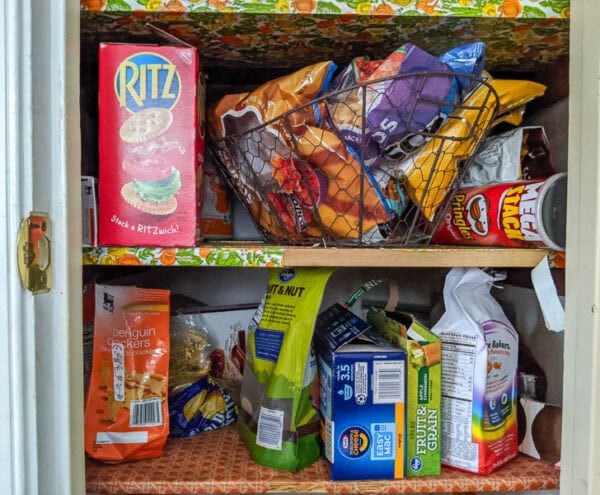
I'm standing in my pantry at nine o'clock at night with my hand in a bag of Doritos, and I am not hungry.
Let me back up.
I had a presentation coming. Big room, real stakes, the kind where the people in the seats decide whether you're worth listening to. And underneath it sat the fear every leader knows and almost nobody wants to admits out loud: I'm going to get up there and look like an idiot.
So I went to the pantry. I always went to the pantry.
Mine is food. It always has been. I like the feeling of being full, that weight, that settling, the way it turns the volume down on everything else. In the moment it's good. It's soothing. It tastes good. There's nothing wrong with any of that, and that's exactly what made it so hard to see.
Because I had the perfect cover.
I'm active. I run marathons and ultras. I've paddled 340 miles down the Missouri River without stopping. Whatever I put in, I burn off. That was my story and I told it well, mostly to myself, and the best part was that it was technically true.
But my story couldn't explain the pantry. It couldn't explain why a guy who can run 50 kilometers was standing in his own kitchen at nine at night, not hungry, eating chips because he was scared of a room full of strangers.
That's not fuel. That's an occupier. It had a job, and the job was making sure I never had to sit with something uncomfortable.
I didn't figure that out by thinking about it. I figured it out by trying to put it down.
The hardest thing I've done wasn't a race. It was a 72-hour fast.
Three days. Nothing to reach for.
I want to be precise here, because this part matters. I wasn't trying to fix my eating. I was trying to find out whether the reach was mandatory. Every time stress came up, every time boredom came up, every time I got that familiar itch to go hand a feeling to a bag of something, there was nothing there. Just me, the feeling, and no exit.
Day one is willpower. Day two is where it gets honest. You find out exactly how many times a day you'd been reaching, because now you feel every single one of them go by unanswered.
Grit is sitting in that and refusing to negotiate.
Purpose is why I sat in it. Because I want to be a sovereign man, not a man being run by a feeling he never even named.
Peace is what showed up on the other side, when I finally understood who was actually in command.
But here's the part that really got me.
Somewhere on day two I found myself standing in the kitchen with my hand on the pantry door. I hadn't decided to walk in there. I didn't want anything. My legs took me, my hand went up, and I was about two seconds from opening it before it registered.
Wait a minute. I'm fasting. What the hell am I doing in here?
I wasn't hungry. I hadn't been thinking about food at all. Some part of me was just running a route it had run a thousand times, and it never once needed my permission to do it.
That's when I understood how deep this went. I thought I had a habit. What I actually had was a program running underneath me, executing on its own, and it had been doing that for years while I congratulated myself on my discipline.
I still like being full. That never went away and it doesn't need to. What changed is that food stopped being the place I take my fear.
That fast worked so well on me that I started running it for other people and do it once a quarter called the Do Hard Things Fast and Focused 31 Day Challenge.
The Bullshit Belief That Keeps You Stuck
Almost everybody gets this wrong, and it's the reason most people never look at any of it.
Bullshit Belief: You either have a problem or you don't.
You're an addict or you're fine. There are people who need help and there's everybody else. And as long as you're holding down the job, showing up for your kids, and not hiding bottles in the garage, you put yourself in the second group and you stop thinking about it.
So you never look. Why would you? Looking is for people with a problem.
That belief is a wall, and it's a tall one. It sets the bar for self-examination so high that almost nobody clears it. People hand over territory for thirty years and never count what they lost, because counting is something only broken people do.
Here's the truth. It was never binary. It's a spectrum, and there's only one question worth asking.
What percentage of my choices are actually mine?
Everybody alive has to answer that one. You don't need a rock bottom to justify taking ground back. You don't have to diagnose yourself as broken before you're allowed to want more command over your own life.
There's a second bullshit belief stacked on top of the first: that willpower is the answer.
It isn't. Willpower is a fuel tank. Identity is an engine. One runs out on you at the worst possible moment. The other doesn't.
What Sovereign Actually Means
Sovereign is a governing word. A sovereign nation makes its own laws. Nobody outside its borders decides what happens inside them. No foreign power sets the agenda. No occupying force gets a vote.
Now put yourself in that sentence.
Personal sovereignty is self-governance. You are the highest authority over your mind, your body, your time, your attention, and your choices. You set the terms. Nothing else does.
In Life on Offense we call it taking command. Same idea, different uniform. Taking command means refusing to let outside forces dictate your life. Your environment isn't to blame. Other people aren't the problem. You're in charge. Lead.
But you can't take command of ground that's already occupied.
And nobody surrenders that ground on purpose. It's slower than that. Quieter. It starts as comfort and it ends as command structure.
We call that a landmine habit, a behavior that sets off a chain reaction of failure. One pint becomes three. Sleep gets wrecked. The alarm goes off and you hit snooze instead of hitting the gym. You're foggy all day. You lose momentum you spent weeks building, over something you never actually chose. You just did what you always do.
When you're on autopilot, you are not in command. Your intention might be to let your higher self run the show, but if you aren't actively leading, your lower self will gladly take the wheel.
And you usually don't know it happened until you try to stop.
Tactic #1: Run the 31-Day Test
Here's the diagnostic. Simple and brutal.
Pick one thing. Stop for 31 days.
Not forever. Thirty-one days. Then pay attention to what comes up.
If it's easy, congratulations. It was a preference, not a grip. You're sovereign there. Move on to the next one.
If your brain starts negotiating, you just found the occupier.
Go back and read that list of excuses at the top of this page. Every one of them is a bid for territory. The intensity of the resistance tells you exactly how much ground you've already handed over.
Most people never run this test. So they spend their whole lives assuming they're free, because nobody ever asked them to prove it.
Now here's the key to succeeding at it. Don't run it in your head.
Now here's the key to succeeding at it. Don't run it in your head.
Pearson's Law says it plain:
When performance is measured, performance improves. When performance is measured and reported, the rate of improvement accelerates.
Write it down. Mark the day. Thirty boxes on a sheet of paper stuck to the fridge if that's what it takes. A test you're running in your head isn't a test, it's a vibe, and that voice we just talked about will quietly revise the record on you when nobody's checking.
Then report it. Text somebody every Sunday with a number. That one move takes you from measured to measured and reported, and Pearson says that's exactly where the rate changes.
If you want to win at this, you need accountability. Not eventually. From day one. More on that in Tactic #6.
The Rent You're Paying
Every habit that has a grip on you charges rent. You just never get an invoice. It gets drafted quietly, automatically, in currencies that matter a hell of a lot more than money.
Self-trust.
Start here, because this is the one that explains why you keep breaking promises.
Every time you say you'll stop and don't, you file evidence against yourself. Not on purpose. You move right past it. You had a good excuse, it was a weird week, you'll get it next time. But something inside you keeps the record. And the record says: what this person promises and what this person does are two different things.
Now go set a real goal. Commit to the business, the race, the hard conversation, the new standard.
Some part of you refuses to buy in. You'll call it fear, or bad timing, or lack of motivation. It's none of those. It's an accurate risk assessment. The person making the promise has a track record, and you've read it.
That's why sovereignty over small things unlocks big things. It was never about the cigar or the dip or the pour. It's that keeping one hard promise to yourself opens a new file, and everything you build after that sits on a foundation you actually believe in.
You can't lead anybody, at work or at home, if your own troops don't trust the commander.
Energy.
The lie is that it costs you the hour you spent on it. It doesn't. It costs you the next eighteen.
The drink doesn't end when the glass is empty. Alcohol wrecks your REM sleep, so you're unconscious for seven hours and rested for about three. The alarm goes off and you hit snooze, because that workout requires a version of you who didn't wake up at three in the morning with his heart pounding. There goes the keystone habit that sets up your whole day. By ten you're reaching for caffeine and carbs because your body is trying to borrow energy you already spent. The hard conversation gets pushed to tomorrow. The work that actually moves your mission gets replaced by email, because email is what a tired brain can do.
Multiply that by a month. That's not a bad night. That's a season of your life running at sixty percent, and you'll call it "getting older."
Presence.
Numbing doesn't discriminate. There's no dial that turns the anxiety down and leaves the joy at full volume. You dull the edge, you dull all of it. The good with the bad. Your kid's story about her day right alongside the stress you were trying to escape.
So you're physically in the room. You're just not mentally there. Nodding at the right times, saying the right words, remembering none of it. The people who love you feel that long before you do. They can't name it either. They just know that talking to you has started to feel like leaving a voicemail.
Ask anybody who's gotten sober what surprised them most. It's almost never the weight or the money. It's that they were actually there, for their kids, their spouse, their own life, for the first time in years. They had no idea how far away they'd been standing until they walked back.
Peace.
You cannot be at peace and be occupied at the same time. It isn't possible.
Because some part of you is always working the problem in the background. Managing the supply. Timing it. Hiding it. Negotiating with it. Justifying it in advance so it doesn't feel like a decision. Planning the trip, the dinner, the weekend around whether it'll be there and who's going to notice. That process runs every waking hour, and it's eating cycles you think you're spending on your life.
That low-grade static? The tightness you feel for no reason? You've had it so long you stopped hearing it. You figure that's just what being alive sounds like.
It isn't. That's the sound of somebody else running the show.
And the wildest part is what happens when it stops. Every client I've walked through this says some version of the same thing, usually around week three, usually looking genuinely confused. "I didn't realize how loud it was until it went quiet."
Tactic #2: Name the Occupier
You can't fight what you won't look at.
Write down what has a grip on you. Not what you should quit. What actually runs you. Be specific.
Then work the four costs, one at a time, and answer honestly.
Self-trust. How many times have you already promised yourself you'd stop?
Energy. What does the energy of the next morning and the rest of the day actually look like?
Presence. Who in your life isn't getting the real you?
Peace. How much of your week goes to managing this thing?
Tactic #3: Change the Identity, Not the Behavior
Most people attack this at the behavior level. I'm going to drink less. That's a rule, and rules need a referee. Every time the moment comes you have to relitigate the whole thing with a tired brain at the end of a long day. You'll lose that argument eventually. Everybody does.
Identity doesn't need a referee.
Listen to the difference in these two sentences. I'm trying to quit versus I don't do that. The first one is a man fighting himself. The second one is a man stating a fact. Nobody argues with a fact, including the voice in your head.
I don't stay disciplined about food because I'm avoiding food. I stay disciplined because I'm an athlete, and athletes don't sabotage their own performance. That's not willpower. That's who I decided to be, and I made that decision one time instead of forty times a week.
Here's what the shift looks like.
I'm cutting back on drinking becomes I'm an athlete in training, and this doesn't fit the mission.
I'm trying to quit dip becomes I don't need a crutch to get through a Tuesday.
I'm doing better with food becomes I fuel performance. I don't manage feelings with a pantry.
I'm trying to cut down on my phone becomes I'm present with my kids. That's not negotiable.
I'm trying to quit cigars becomes I'm a man who can sit with a hard day without needing something to take the edge off.
Read those out loud and you'll hear it. The left side is a diet. The right side is a person.
Now here's the part most people skip. You have to actually connect with it.
An identity you don't believe is just a slogan, and slogans fold the second things get hard. It has to be something you genuinely want to be true about you, tied to something bigger than the habit itself.
So get specific about it. Who is watching? My daughters are watching, and they are going to describe their father to somebody someday. That description gets written by what I do on ordinary Tuesdays, not by what I say on New Year's Eve. That's a reason that holds up at nine o'clock at night when I'm standing in front of the pantry.
Find yours. Your kids. Your spouse. The soldiers or the team or the clients who take their cues from you. The version of yourself at seventy that either got there strong or didn't. Something with a face on it.
Then answer two questions and answer them out loud.
Why aren't you doing this thing anymore? Because of who you are. Not because a program told you to.
How do you stay disciplined? By feeding the habits that make you stronger and starving the ones that make you weaker.
Then watch what happens. Every choice that lines up with the new identity becomes evidence for it. You're not white-knuckling your way through a rule, you're building a case for a person. After a few weeks that case gets pretty hard to argue with, and the choices start making themselves.
Decide who you are. Connect to why it matters. Most of the decisions disappear after that.
Tactic #4: Engineer the Environment
Willpower is the most expensive tool you own, and it's the one that runs out fastest. It's gone by six o'clock, right when you're fried and hungry and the day already beat you up. That's the exact moment you're asking it to perform.
So quit spending it. Change the terrain instead.
James Clear says it simply in Atomic Habits: put distance between you and the thing. Every step you add between the cue and the reach is another step where the craving can die on its own. Most cravings don't survive four minutes and a locked door. They only survive when the thing is eighteen inches away.
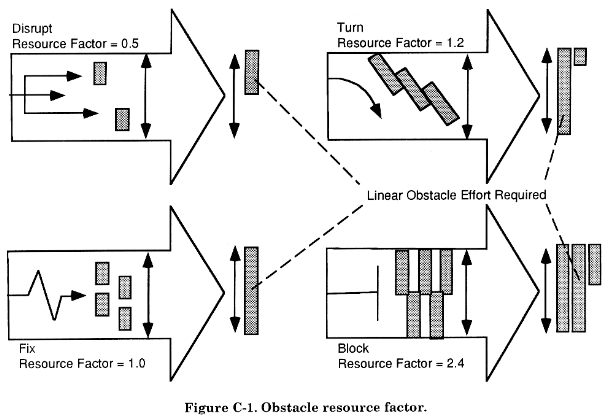
I spent my career as a combat engineer, and this is exactly what we did for a living.
Engineers do three things:
Mobility, we open ground so our own forces can move.
Countermobility, we deny ground to the enemy and shape where he's able to go.
Survivability, we protect what matters.
Countermobility is the one that applies here, and it's an entire discipline built on one idea: you don't leave the enemy's movement up to the enemy.
You study the ground. You figure out how he wants to move. Then you emplace obstacles so his easy route stops being easy, and the route you want him on becomes the path of least resistance.
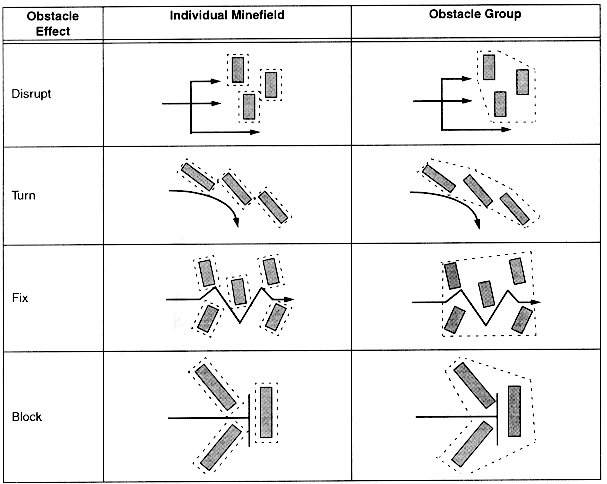
Doctrine gives us four effects, and every one of them works on your own bad habit.
Disrupt. Break up the flow so the thing can't run clean. The habit is a chain: cue, craving, reach, reward. Put one piece of grit in the middle of it. Don't keep it cold. Don't keep it in the room where you unwind. Make it take four steps instead of one. You're not trying to make it impossible, you're trying to make it clumsy, because a clumsy habit gives your brain time to catch up and ask what you're doing.
Turn. Redirect the movement to ground you choose. You're not going to kill the cue, so give it somewhere else to go. Stock the good sparkling water, the expensive kind you actually like. Put the running shoes by the door you walk in through. When six o'clock hits and the itch shows up, the itch is going to go somewhere. Decide in advance where.
Fix. Hold it in place and take away its speed. Put a rule between you and the reach that costs time. Ten minutes before you decide. Or a hard one I like: you can have it, but you have to write down what you're feeling first. Most of these habits only work at the speed of reflex. Slow it to the speed of a decision and you'll be shocked how many of them just quit.
Block. Deny the terrain completely. Get it out of the house. Not because you're weak, but because a habit needs something to reach for, and you can't reach for what isn't there. If it's in the pantry you're relying on discipline forty times a week. If it's not in the pantry you relied on it once, at the grocery store, when you were rested and clear-headed and strong. That's a much better fight and you get to pick when you have it.
Then plan for terrain you don't own. This is where most people get taken out. You've got the house handled because it's the terrain you own and dominate, and then you walk into your cookout at your brother-in-law's.
Show up supplied. Bring your own cooler with whatever you're drinking now. Eat before you go if food is your thing. Get something in your hand before anybody offers you anything, because an empty hand at a party is an invitation.
But let's be real about what happens next, because this is the part nobody prepares for.
Somebody is going to notice. First the look, then the questions, then somebody gives you a hard time. Come on, one's not going to kill you. Since when? Who are you now? And most of them aren't being cruel. They're not really thinking about you at all. You stepped outside the box, and a man who's changing makes people uncomfortable, because your choice quietly asks them a question about theirs.
That's the real obstacle at a cookout. It was never the beer. It's the eyeballs and opinions.
So plan your answer before you're standing there with everybody looking at you. Keep it short and do not explain.
"I'm good."
"Not tonight."
"I don't drink anymore."
Notice that not one of those is an argument. The second you start justifying yourself you've opened a negotiation, and now you're outnumbered and tired and holding nothing.
This is where Tactic #3 pays for itself. I'm trying to cut back invites a debate. I don't do that ends one. Say it flat, keep something in your hand, change the subject.
It's awkward for about nine seconds. Then it's over. And it gets less awkward every single time until one day nobody brings it up at all.
And be honest that your environment includes people. Who you spend Friday night with is an environmental choice, and it's the one nobody wants to look at. You don't have to fire anybody. But you know which rooms make this easy and which rooms make it hard, and pretending otherwise is a decision too.
Shape the ground before the fight. The best battle is the one you set up in advance.
Tactic #5: Own Your Orders and Report Them
In the Army we say own your orders. It means you take full responsibility for the mission, whether or not the order started with you. You don't tell your soldiers it came from somebody else. You own it, and then you go execute it.
Same thing here.
Whatever path you take and whatever actions you choose, they're yours. Nobody made you. Your buddy brought a bottle over, and you're the one who opened it. It was a rough week, and you're the one who decided what a rough week entitles you to. Your schedule is yours. Your pantry is yours. Extreme ownership, all of it.
But here's the half everybody forgets. Owning your orders in the Army doesn't mean going quiet and doing it alone. You have a battle buddy to hold you accountabilt. You report. You brief up. Somebody knows the status of your mission and somebody is going to ask you about it.
Go public and burn the ships.
Say it out loud, to people, on purpose. Tell your spouse. Tell your crew. Put it on social if that's where your people are. The moment you announce it, you burn the boat you were planning to retreat on. The quiet exit disappears. Backing out now costs you something in front of people whose opinion you actually care about, and that cost does real work for you at nine o'clock at night when nobody's watching.
That's the whole point of burning the ships. You don't fight as hard when there's a way home.
Then name your witness.
Going public kills your retreat. It doesn't guarantee follow-up. A hundred people will like the post and not one of them is going to text you on day nineteen to ask how it's going. Announcing is the burn. Reporting is the mission, and reporting needs somebody on the other end.
So pick one person and give them the job on purpose. Out loud. Here's what I'm doing, here's the number I'm tracking, and I'm sending it to you every Sunday.
Pick somebody who'll actually hold your feet to the fire, not somebody who loves you enough to let you off. You know which of your people is which. The right one will ask on Sunday even when you go quiet, and especially when you go quiet, because quiet is the tell.
Remember Pearson from Tactic #1. Measured improves. Measured and reported accelerates. Going public is how you commit. The witness is how you report. You need both.
The Do's and Don'ts
Don't announce it to everyone and no one. A post to five hundred people isn't accountability. One person who'll actually call you beats fifty who won't.
Don't white-knuckle it while the trigger stays in the house. That's choosing to fight a battle you could have avoided. Willpower is the most expensive tool you own. Quit leading with it.
Don't treat a slip as proof you can't. Treat it as data about your environment. Something in your setup made the wrong choice easy. Go fix that, not your character.
Don't swap one occupier for another and call it a win. Putting down the drink and picking up the phone isn't sovereignty. That's a change of management.
Do start with the smallest one. Sovereignty compounds. That evidence file works both directions, and one kept promise is the first entry on the right side of the ledger.
Your Orders
Four of my clients went after this in the last month.
One cut his drinking way back. One quit cigars. One threw out the Velo. Another looked at the bottle and decided it doesn't get a vote anymore.
Not one of them called it quitting. Every one of them said some version of the same thing. "I'm tired of that thing running me."
And not one of them described the payoff in pounds or dollars, though those came too. They talked about clarity. Sleep. Being present. Waking up and recognizing the person in the mirror.
That's the whole equation.
Grit gets you through the discomfort, the awkward party, the Tuesday night when you'd normally reach for it.
Purpose is why it's worth it, the reason bigger than yourself that makes the discomfort make sense.
Peace is what's waiting on the other side. It's always last. It's always the payoff.
Sovereignty isn't a personality trait. You weren't born with it or without it. It's territory you defend one decision at a time, and you take it back the same way it got taken. Slowly, quietly, daily.
So here are your marching orders, and you execute today. Not Monday.
Pick one thing. Just one. Write down what it costs you across those four currencies. Then run the 31 days.
Not to prove you're tough. To find out who's actually in command.
And if you'd rather not do it alone, that's exactly what I built.
Fast and Focused 31 Day Challenge: opens with the 72-hour fast. Three days of nothing to reach for, so you find out what you've been reaching for and how often. It's the fastest diagnostic I know. Most people are stunned by what surfaces.
Then it rolls straight into DHT 28, twenty-eight days of taking the ground back. You track and measure and score points in the Energy Driver Habits - High Performance Energy Drivers proven to optimize your ENERGY - Scoring and tracking your Nutrition, Hydration, Movement, Mindset, Rest and Recovery and Discipline Rituals.
The fast is a hard reboot of the body and shows you what has you. The 28 days is where you take the ground back.
I run it quarterly. Get on the list and you'll know when the next one opens.
Get on the31 Day Fast and Focused list →Contact — Do Hard Things Nation
So what's running you that you never chose?
Find it. Name it. Take the ground back.
You're the captain of your ship. Take Command.
Now let's get to work.
A 72-hour fast isn't for everybody, and it was never the point. If you're pregnant, managing diabetes, taking medication that requires food, or you've got any history of disordered eating, talk to your doctor first. The point is finding your own version of nothing to reach for.
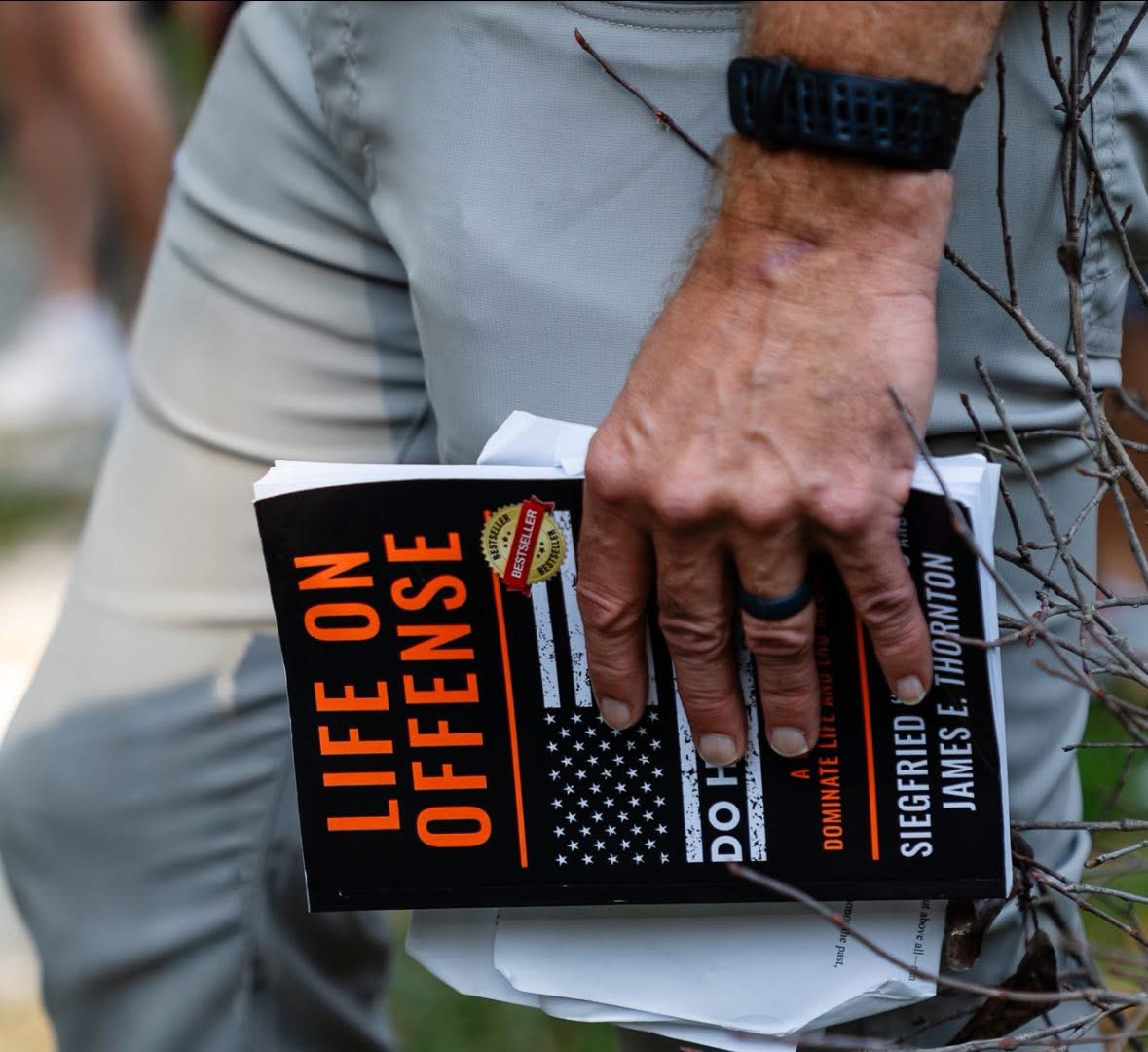
Siegfried "Sig" Tiegs is a keynote speaker, high-performance coach, and co-author of the Amazon best seller Life on Offense: A Tactical Guide to Dominate Life and End Mediocrity. A retired Army Major with 27 years of service, he hosts the Do Hard Things™ podcast and coaches high performers at dohardthingscoaching.com.
GRIT. PURPOSE. PEACE.
Don't miss a beat!
New moves, motivation, and classes delivered to your inbox.
We hate SPAM. We will never sell your information, for any reason.