Everything You Know About Skunks Is Wrong.
Sep 08, 2026Everything You Know About Skunks Is Wrong
What else are you sure about that you've never checked?
By Siegfried "Sig" Tiegs Columbia, Missouri
"It ain't what you don't know that gets you into trouble. It's what you know for sure that just ain't so."
— Commonly attributed to Mark Twain, who almost certainly never said it. Which is about as perfect as it gets.
I woke up to the light on and the shower running.
Lacy was already moving, fast, and as my eyes came open the next sense kicked in and I caught a waft of something I couldn't place. Sharp. Chemical. Wrong.
"What's going on? Are you okay?"
"Koda got sprayed by a skunk."
I looked at the clock. 2:03 in the morning.

Koda is our five-year-old shepherd mix. She had gone out for a bathroom break and come back with a direct hit to the ear and neck.
Here's the thing nobody tells you. What you think skunk smells like isn't what skunk smells like. Everybody knows the roadside version, that whiff of nastiness you catch doing seventy on the highway and lose again in twenty seconds. A direct hit at close range is a completely different animal. Sharp, chemical, burnt rubber, like somebody set a tire on fire in a garlic patch. And it does not stay on the dog. It gets into the drywall. I spent twenty-seven years in the Army and I have smelled some things. This one had its own category.
My first coherent thought, standing in the hallway in my shorts, was that we didn't have any tomato juice.
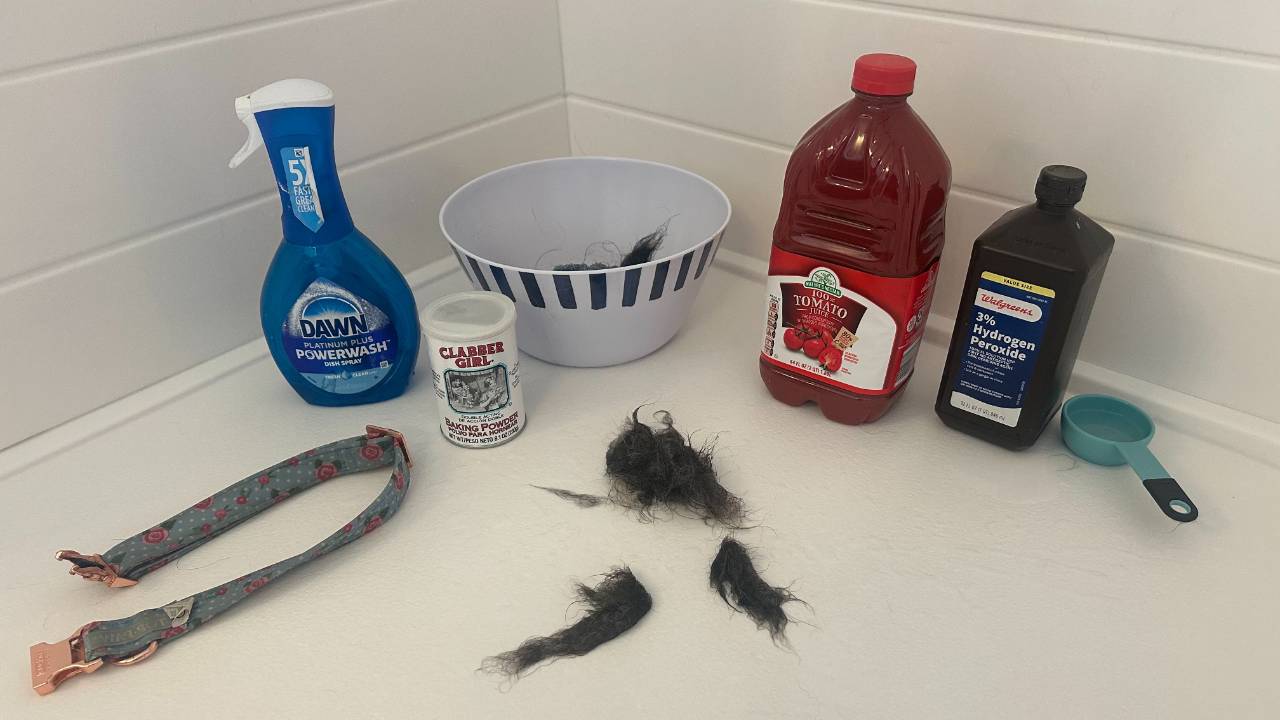
Because that's what you do. Everybody knows that. My grandmother knew it, your neighbor knows it, and Google will still tell you so this morning. The problem is that it doesn't work. Tomato juice masks the smell without neutralizing it, so what you get for your trouble is a wet red dog, a ruined bathroom, and the same problem back in two days.
What actually works is a formula a chemist named Paul Krebaum published in the early nineties. Two cups of three percent hydrogen peroxide, a quarter cup of baking soda, and a couple of squirts of Dawn. Mix it fresh in an open container and never seal it in a bottle, because the reaction gives off oxygen and a capped container will burst on you. We ran it twice, followed it with dog shampoo, and got most of it out. Most of it still means a dog who smells like a chemical fire, so we spent this morning tracking down an enzyme shampoo to finish the job.
The reason it works is the mechanism. Skunk spray is built out of compounds called thiols, and the peroxide and the baking soda oxidize them into something with no smell at all. The molecule itself changes. Tomato juice never touches the thiol. It sits on top of it and waits to wear off.
By a quarter after three we were standing in our bathroom with a soaking wet dog who looked deeply betrayed by both of us.
What I couldn't stop turning over, though, wasn't that I had been wrong. It was how sure I had been. Tomato juice wasn't a guess I would have defended if you pushed on it. It was a fact I had, the same way I have the fact that stop signs are red. I couldn't tell you where I picked it up or when. And in forty-some years it never once occurred to me to check.
Some of what we run our lives on is exactly like that, and the tricky part is that you can't tell which parts from the inside. The advice about building a business, saving a marriage, dropping weight, raising a kid. A lot of it got handed down because it was easy to hand down, not because anybody ever tested it. Nobody in the chain is lying to you either, which is exactly what makes it hard to catch. Your neighbor believes in the tomato juice. He heard it from somebody who heard it from somebody, and it has been riding on nothing but confidence for forty years.
Bad advice has a signature and it's worth learning to spot. It makes you feel better fast and it changes nothing underneath. The account looks better this month while the spending that emptied it sits untouched. You had the big talk on your anniversary and the way the two of you speak to each other on an ordinary Tuesday is exactly what it was. You dropped nine pounds in three weeks and the reason you end up in the pantry at nine at night is still right there waiting on you.
You're not lazy and you're not undisciplined. You've been handed a bottle of tomato juice and told it was medicine.
The same thing runs through most companies. Somewhere in yours is a process that exists because it has always existed, and if you asked the person running it what it actually accomplishes, you'd get a description of the activity instead of the result. That's a bottle of tomato juice with a budget line and a recurring meeting.
I've been sitting with all of this for a couple of days now, because the diagnosis we landed on for Koda was tomato juice too. When we picked her up on Labor Day she wasn't right. Low energy, struggling to lay down, not herself. We called some friends, did a little reading, and settled on heat exhaustion. It was hot, she'd been boarded, and the answer fit well enough to let us wait until morning. It made us feel better and it changed nothing.
That was tomato juice, and I didn't recognize it, because I was the one holding the bottle.
Lacy took her to the emergency vet that night. We still don't know what's wrong with her.
The skunk turned out to be the easy problem. It was loud and it was urgent and it had a known cause and a known fix, and it was handled before sunrise. The quiet one is still open, and I'm not going to tie a bow on it here, because that would be the same move I've spent this whole letter warning you about.
What I'd offer instead is a way to check. Pick one thing you're doing right now because somebody told you it works. Something in your business, your marriage, your health, your money. Then run it through three questions.
Where did I get this? If you can't name where it came from, then that could be a red flag. That doesn't make it wrong. It does mean nobody in the chain has checked it in a long time, and that includes you.
How does the process actually work? Walk the steps out loud, start to finish. The peroxide works because it does one specific thing. It oxidizes the thiol, and the smell is gone for good. That's a process. If all you can name is what goes in and what's supposed to come out, you don't know how it works. You only know that it's supposed to.
How would I know if it stopped working? Name the signal and name the date. What would you expect to see, and when would you expect to see it? If you can't answer that one, you're not measuring anything. You're believing something. That's how tomato juice survives forty years. Nobody ever goes back to check.
The next time somebody tells you that's just how we've always done it, run the three questions before you nod.
Do Hard Things
-Sig

Siegfried "Sig" Tiegs is a keynote speaker, high-performance coach, and co-author of the Amazon best seller Life on Offense: A Tactical Guide to Dominate Life and End Mediocrity. A retired Army Major with 27 years of service, he hosts the Do Hard Things™ podcast and coaches high performers at dohardthingscoaching.com.
Field Notes is a series of quick dispatches from real life — the small moments that carry the bigger lessons. dohardthingscoaching.com
Don't miss a beat!
New moves, motivation, and classes delivered to your inbox.
We hate SPAM. We will never sell your information, for any reason.