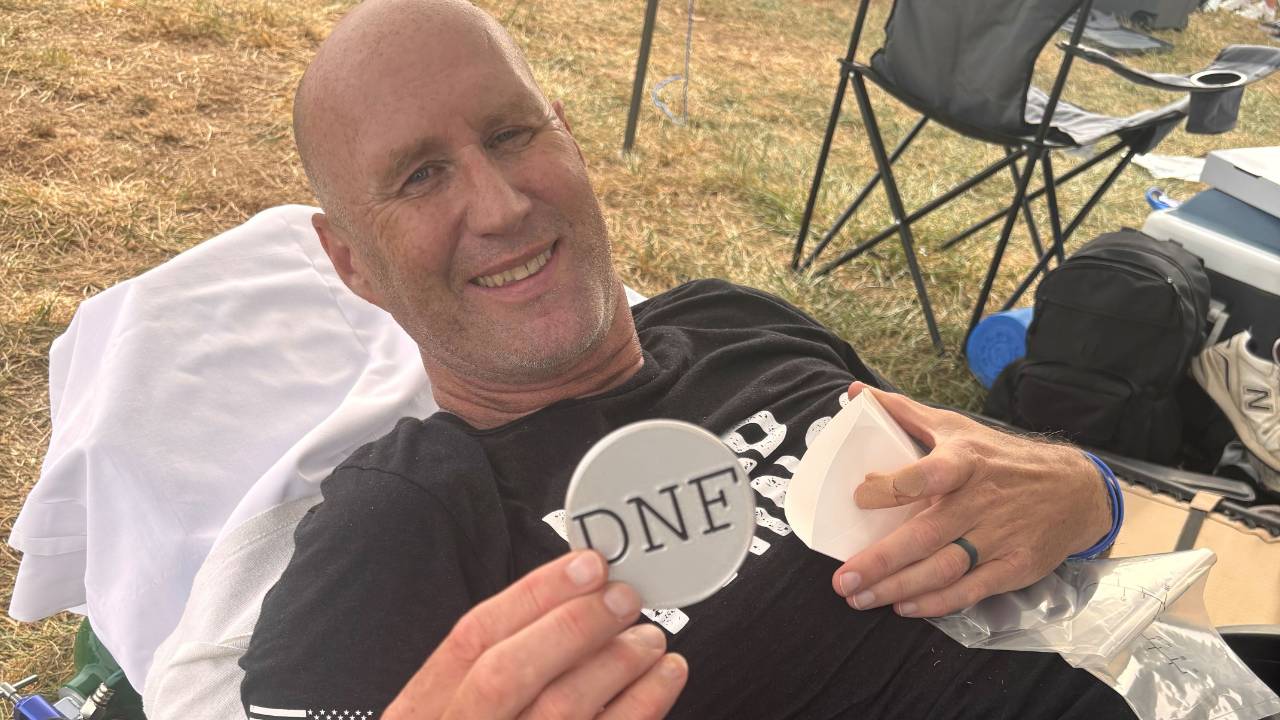
My First Backyard Ultra Put Me in the Hospital With Rhabdo. Here's What I Learned.
Oct 16, 2026Have you ever finished a race and just knew something was off?
Last weekend, that was me. I was lying on the ground next to my tent. My vision was blurry. I was so nauseous I didn't know which end it was going to come out of, and I could see the bathroom across the grass but didn't have it in me to get up. Then I broke into a cold sweat.
Pride and ego aside, I looked at my wife Lacy and told her we needed to call EMS. A few hours later, I was in the hospital with rhabdomyolysis, aka rhabdo.
I'm happy to report I'm here writing this, so obviously I survived. But in the moment, I didn't know if I was going to. I'd heard about rhabdo. This was my first experience with it, and it caught me off guard and scared me.
That's the bottom line of this whole Do Hard Things movement: I do hard things so you don't have to. I learn the hard way, and you get the lessons. So if you run, ruck, ride, race, or CrossFit, this one's for you. And if you crew for someone you love, this one's for you too, because you need to know the signs.
One quick note: I'm not a doctor. I'm a guy who spent eight hours in the hospital learning this the hard way. Talk to your own doctor about your own situation.
Why We Went
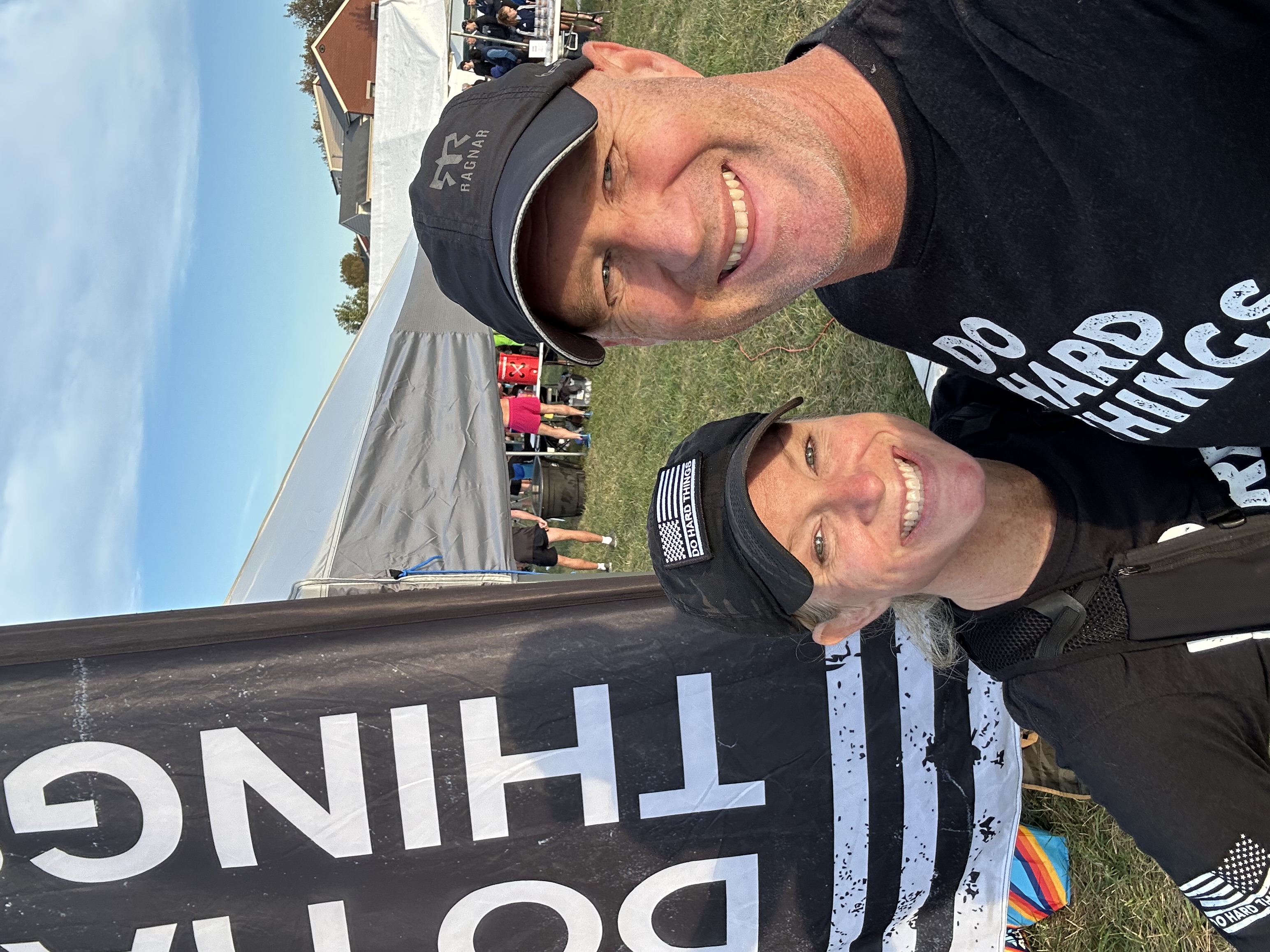
Lacy decided on Friday that we were going to do a backyard ultra. Our kids are in college and high school sports, and with soccer and football season in full swing, we've been go, go, go. This was the first weekend with nothing big planned. The only thing on the calendar was our friend Craig's wedding on Saturday.
The weather was going to be beautiful, and we'd been considering the backyard ultra format for a future Do Hard Things event. So the plan was simple: run a few laps, then head to the wedding. We hadn't been training specifically for this, but we run. We figured we could muscle through it. No big deal.
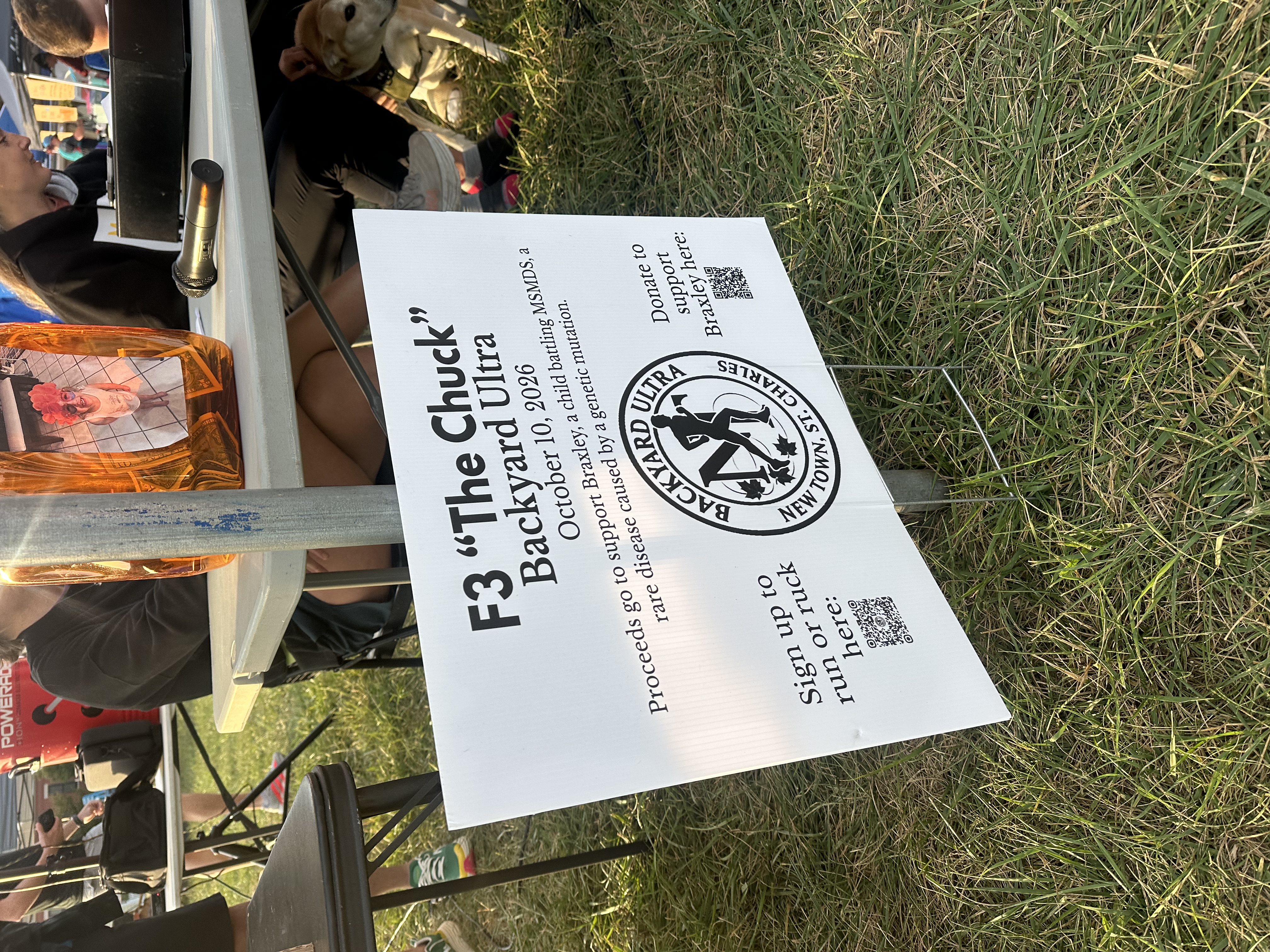
We found the 2nd Annual Backyard Ultra at New Town in Saint Charles, Missouri, put on by F3 as a fundraiser.
How a Backyard Ultra Works
You run a 4.17-mile loop every hour, on the hour. Whatever time you have left is your rest, and most people set up their own tent like a pit stop. At the top of the hour, you line back up and go again.
What I like about it is that it's not based on speed. There's strategy, because you don't want too much time sitting around, but you're constantly with people. That's different from a 50K, where it's one nonstop race. And in this format, everyone DNFs except the last person standing, which is very humbling.
Every lap, you put a dollar in a jar. Half goes to the winner and half goes to the charity, which for this race was MSMDS, supporting Braxley.
The format comes from Big's Backyard Ultra in Tennessee, put on by the infamous Laz, the same host behind the Barkley Marathons. At 4.167 miles an hour, 24 hours is exactly 100 miles, and the best in the world have kept going for more than 100 hours.
The pace sounds really easy. That's the trap.
The Race
Our first lap started at eight in the morning. It was a beautiful route through New Town, a neighborhood of town homes and little shops with canals running through it, all decorated for Halloween. You loop through the neighborhood, hit a stretch of cinder trail on the back side, and come back in. Same lap, over and over.
Lap one, no big deal. We came in with about fifteen minutes to spare, drank some water and electrolytes, and lined up again. Lap two, no big deal. By laps three and four we started to feel it. The temperature was climbing, and we were getting into some distance, around sixteen miles.
On lap five, Lacy started cramping in her legs. We'd talked about going for seven or eight laps, which would've put us at 50K, but we also had a wedding to get to. Her friend Jen showed up to cheer us on, and Lacy called it. I had time to spare, so I decided to go for one more.
I knew I was starting to feel it myself. When lap six started, my light jog turned into a walk. I told myself I'd just walk it in and we'd be done.
About halfway through, right before the cinder trail, I passed a runner who was dry heaving on the side of the course. We cheered her on. Then she caught up to me and asked how I was pacing and whether I thought I'd make the cutoff. I crunched the numbers and told her honestly that I didn't think I would. I didn't have any gas left in the tank. She took off looking for someone to pace her in, and I cheered her on: "Great rally. Let's go, do hard things."
Inside, I was getting worse with every step. I'd felt this before and thought I was just hitting the wall. At the end of the cinders, with about a mile and a half to go, my vision went blurry and a big wave of nausea hit. I don't get nauseous very often. I got down on my hands and knees in the grass for a minute and kept my head above my heart so I wouldn't pass out.
A motorcyclist pulled up and asked if I needed anything. I told him I was good and could muscle through it.
I got back up, made it into the neighborhood, and with less than a mile to go, I found myself sitting on someone's porch. My vision was still blurry, and it wasn't going away.
Lacy and Jen were on the corner cheering me in. Lacy was poking fun at me a little, but she didn't realize how bad I was feeling. I crossed the finish line, went straight to my tent, and lay down.
The Tent
I crawled into my chair and grabbed a Coke. When you're doing hard things, Coca-Cola is amazing. They brought me an empanada from the food trucks, and even though I was hungry and it smelled great, I couldn't choke it down.
I ended up back on the ground. Lacy said I was rolling around, and at one point I was next to another group's camp. Another wave of blurry vision and nausea hit, and I thought I was going to lose it from both ends right there. I could see the bathroom. I could not get up.
Then came the cold sweat. I'd been wondering if I could ride it out, but when that sweat hit, I looked at Lacy and said, "We need to call EMS."
I had to put my pride and ego aside. I didn't want the drama. It felt embarrassing. But I knew something was off, and calling was the right thing to do.
The Ambulance and the ER
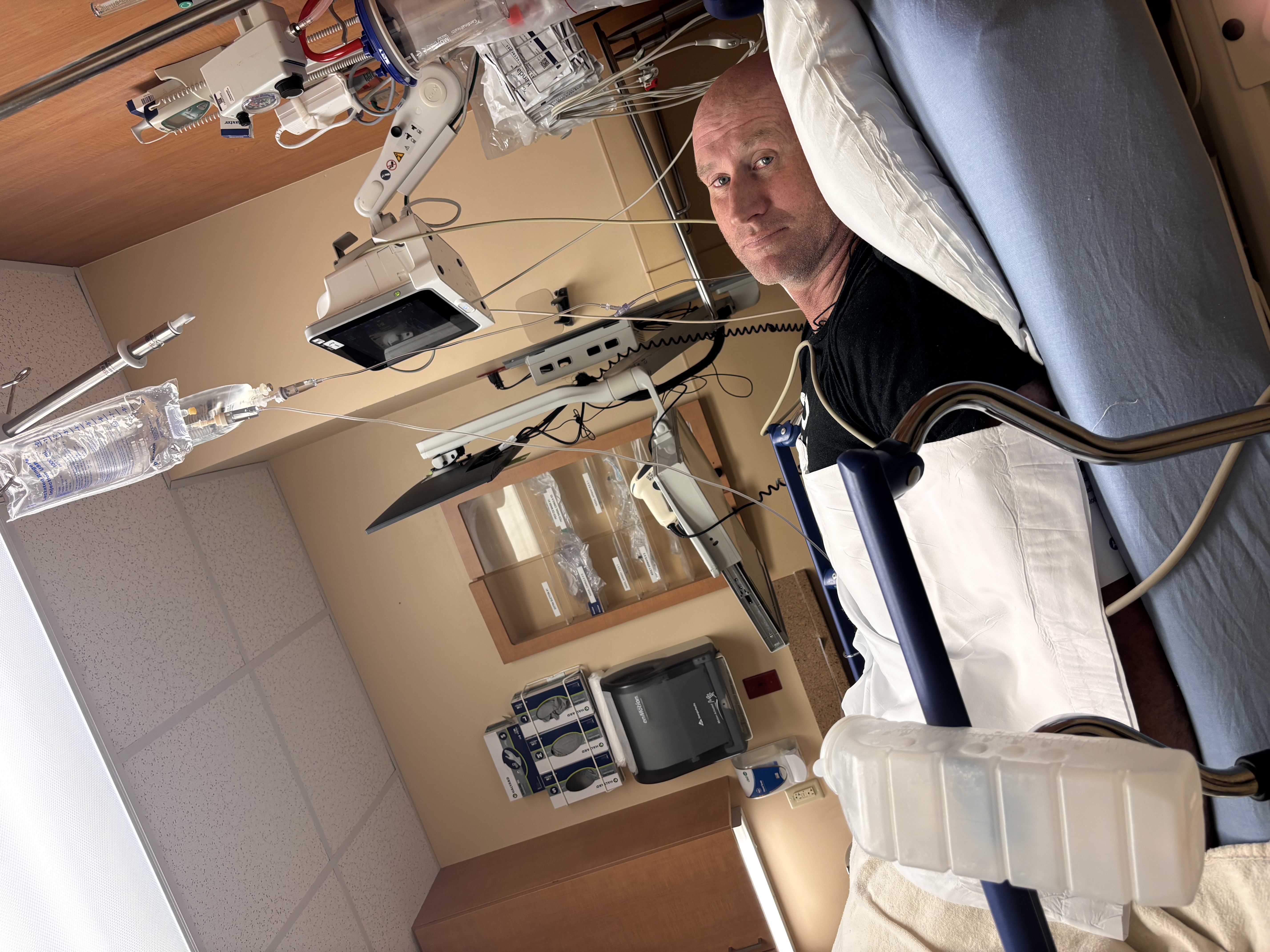
By the time EMS arrived, I was feeling a little better, but my vision was still blurry. They took my vitals and asked me questions. I was coherent, but my heart rate was super low, and my blood pressure was around 78 over 50. Normal is around 120 over 80.
They asked if I wanted to go to the ER, where they could give me fluids. I hate going to the doctor. I'd never been in an ambulance. People were watching. But I knew I needed to do the right thing, and I knew fluids would make me feel better. So I went.
It was my first ambulance ride, and the crew, Danny and Grant, were great. They started an IV and got me to the ER, where they ran an EKG, drew blood, and gave me Zofran for the nausea. I was freezing in my sweaty clothes and starving after burning all those calories.
Then the doctor came in and told me I had rhabdo.
My CK was over a thousand, when normal is under about 200. My potassium was over 5, when normal is 3.5 to 5.
I spent about eight hours in the hospital. My blood pressure kept fluctuating, and they didn't know if I'd be going home that night. Eventually it stabilized, my labs showed my kidneys were working, and they let me go. We booked a hotel near the ER just in case, since we were two hours from home.
What Rhabdo Is
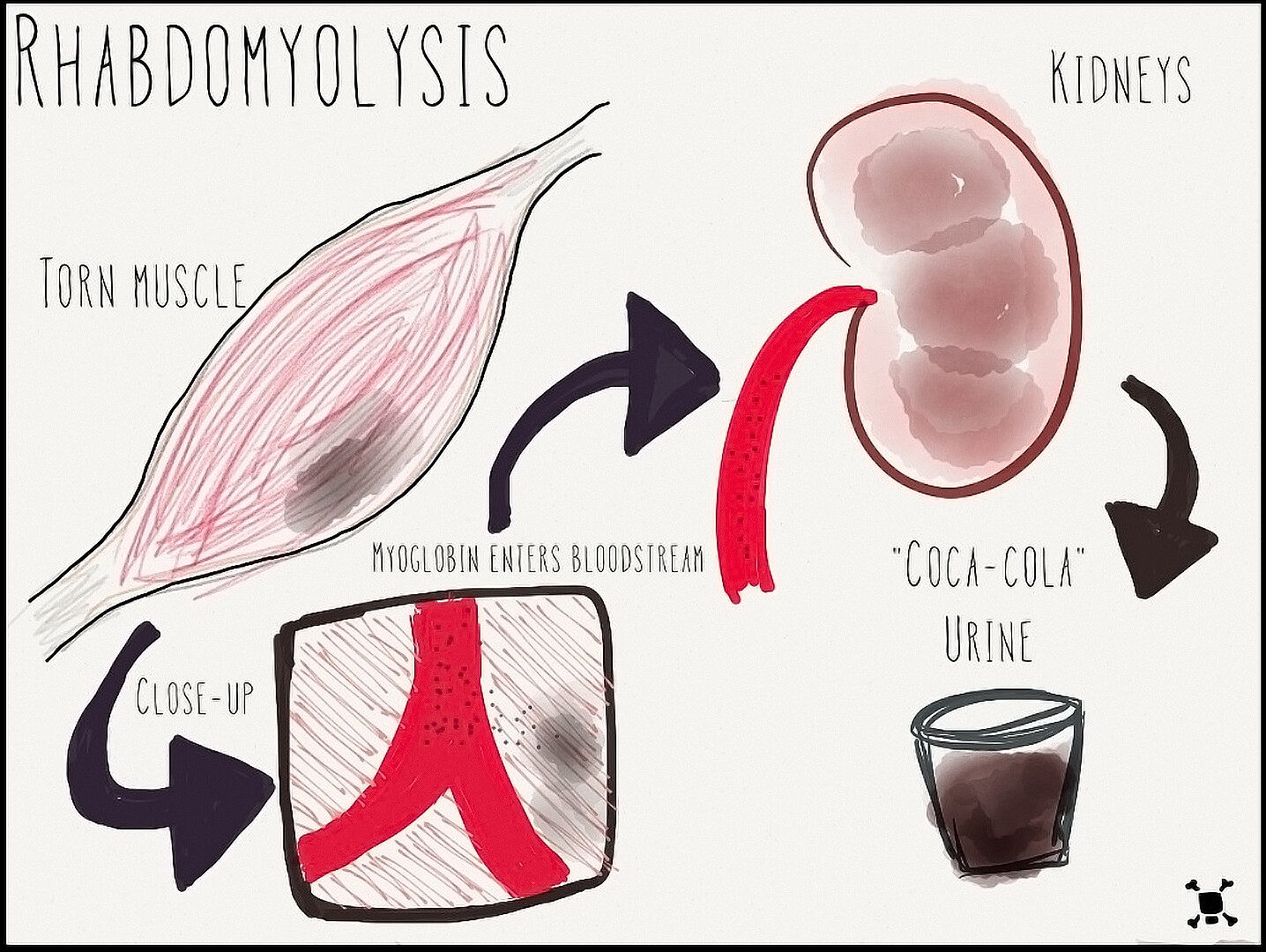
Rhabdo is short for rhabdomyolysis. Break the word down: rhabdo means rod, the shape of your muscle fibers. Myo means muscle. Lysis means breaking apart. Muscle fibers breaking apart.
It happens when muscle breaks down so fast that what's inside the cells floods your bloodstream faster than your body can clear it. When exercise causes it, it's called exertional rhabdo. Three things spill out:
- CK (creatine kinase). An enzyme that lives inside your muscle cells and helps them make energy. When muscle breaks down, CK leaks into your blood, so the more CK in your blood, the more muscle has broken down. That's why doctors test for it. Mine was over a thousand, five times normal or more.
- Potassium. This one hits your heart. Too much can throw off your heart rhythm.
- Myoglobin. This one hits your kidneys. Your kidneys have to filter it, and too much at once clogs them up, like food particles clogging a kitchen sink. That's acute kidney injury, and that's the real danger.
That's why the treatment is fluids, and a lot of them. Fluids flush your kidneys and protect them.
The crazy thing about rhabdo is that you can't tell how bad it is by how you feel. You need a blood test.
How Athletes Get It
The military. In 2024, there were 464 cases of exertional rhabdo across the active-duty force. About four in ten were hospitalized, and recruits in basic training get it at more than 13 times the rate of everyone else. That's often someone fairly sedentary suddenly doing a lot of hard exercise. But seasoned athletes get it too. When I was at Fort Leonard Wood, we'd see it at the Best Sapper Competition, where tactical athletes push themselves to overexertion. We saw it with our lieutenant trainees. It was fairly common.
College football. In 2011, 13 Iowa football players were hospitalized after offseason workouts. They'd just come back from winter break, and their symptoms were soreness all over and tea-colored urine. In 2017, three Oregon players were hospitalized after workouts that came right after six weeks off, reportedly including an hour of continuous push-ups.
Spin class. One medical report in The American Journal of Medicine counted at least 46 cases of rhabdo after a spin class. Forty-two of those people were taking their first class.
CrossFit. People get it after the Murph: a one-mile run, 100 pull-ups, 200 push-ups, 300 squats, and another mile, often in a weighted vest. That's significant load. I recently learned of some super-fit people in the CrossFit world who got it.
See the pattern? Time off, or something new. A big jump in intensity. The same muscles over and over.
That was me. A format I'd never done. Same loop, same muscles, every hour on the hour.
What I Learned
Soreness doesn't mean you're fine. At first, muscle breakdown feels like normal soreness. But normal soreness peaks a day or two after a race and then gets better. Rhabdo can show up days after the big event. If your soreness isn't peaking and getting better, and your muscles are swelling, that's a warning sign. That wasn't my case, since mine hit in the middle of the event, but it's common with CrossFitters after workouts like the Murph.
Ibuprofen masks the problem. A lot of runners take ibuprofen during races. I've done it myself. It masks the pain, but during a long effort it adds stress to your kidneys, the same kidneys rhabdo puts at risk. And it hides the signals you need to see, hear, and feel.
Hydrate before the event, and don't overdo it during. Too much plain water drops your sodium. That's called hyponatremia, and it causes nausea and confusion. It's a big challenge with military trainees. Drink to thirst and take electrolytes with it.
The Perfect Storm
Here's the embarrassing part. Looking back, I can see it plain as day.
I'm 48. I'm no spring chicken. I'm not going to stop doing hard things, but I can't rely on sheer grit anymore. I have to be smarter going in.
I went in dehydrated. Look at the 72 hours before the race. Wednesday night, I had a couple of old fashioneds and a beer. Thursday I was tired, drank a little water, and overdid the caffeine. Friday, when Lacy made the call to race, I realized I needed to start drinking water, but by later that day I was already behind the power curve. I usually do a good job with hydration. I aim for about a gallon of water a day. It was just an off week.
I wasn't sleeping well, either. When we got up that morning, I felt like I could've gone back to bed and slept most of the day.
Then I took on a new format I hadn't trained for, with the stop-and-start and the heat.
I've done way harder things and muscled through them. That's what surprised me. But this was a perfect storm. I won't do it again, and I don't recommend it to anyone.
Birth Queen Health
The Signs
Know these:
- Dark urine, the color of tea or cola. That's a big one.
- Muscle pain or swelling way beyond normal soreness.
- Peeing a lot less than usual.
- Nausea or vomiting.
My signs were blurred vision, nausea, a sweat that came out of nowhere, and a heart rate that was off.
If you see the signs, let someone know.
Knowing When to Stop
This is the hard one. I'm inspired by the videos of people crawling across the finish line on their hands and knees. They can be incredibly inspiring. But some of those athletes might be pushing hard enough to do real damage.
Knowing when to grind to the finish and when to stop is hard. And if you're a determined, stubborn athlete, you can make the wrong call. When you're in the thick of it, you're not making your best decisions.
So before your next race, write down your stop signals. Then make sure your crew knows them, and knows the signs. If you're supporting someone, you need to know when to stop them.
Recovery
Since then, I've felt really tired, and I'm taking it easy. I have an adventure race coming up in two weeks, and I'm disappointed, but I'm not doing it. I'm going to take it easy for the next couple of months.
I go back for labs this week to make sure everything is working. In the meantime, I've been doing yoga and stretching. I think of Jocko: when you can't do what you want to do, "Good." It's an opportunity to focus on something else. So I'm focusing on flexibility, yoga, and strength until I bounce back.
Bottom Line
Rhabdo is a real risk to athletes. It can kill you, so don't play around with it. Know the signs, know your stop signals, and make sure your crew knows them too.
Most of the people in our community are somewhere between 30 and 60. This is humbling, but you're no spring chicken either. The things you used to do, you can still do. You just have to do them wisely.
Keep getting after it, but be smart.
And be on the lookout for the Do Hard Things Backyard Ultra. Despite my first time, I love the format. Next time, I'll train properly and show up fully hydrated and prepared. It's not something you go into willy-nilly.
Have You Had Rhabdo?
If you've had rhabdo, or you think I'm missing something, share your experience in the comments. Your story could help someone else catch the signs sooner.
Listen to the full episode on the Do Hard Things Podcast. And join the conversation in the free Do Hard Things Nation Facebook group.
I'm not a doctor. This post is for education and entertainment only. Talk to your own doctor about your own situation.
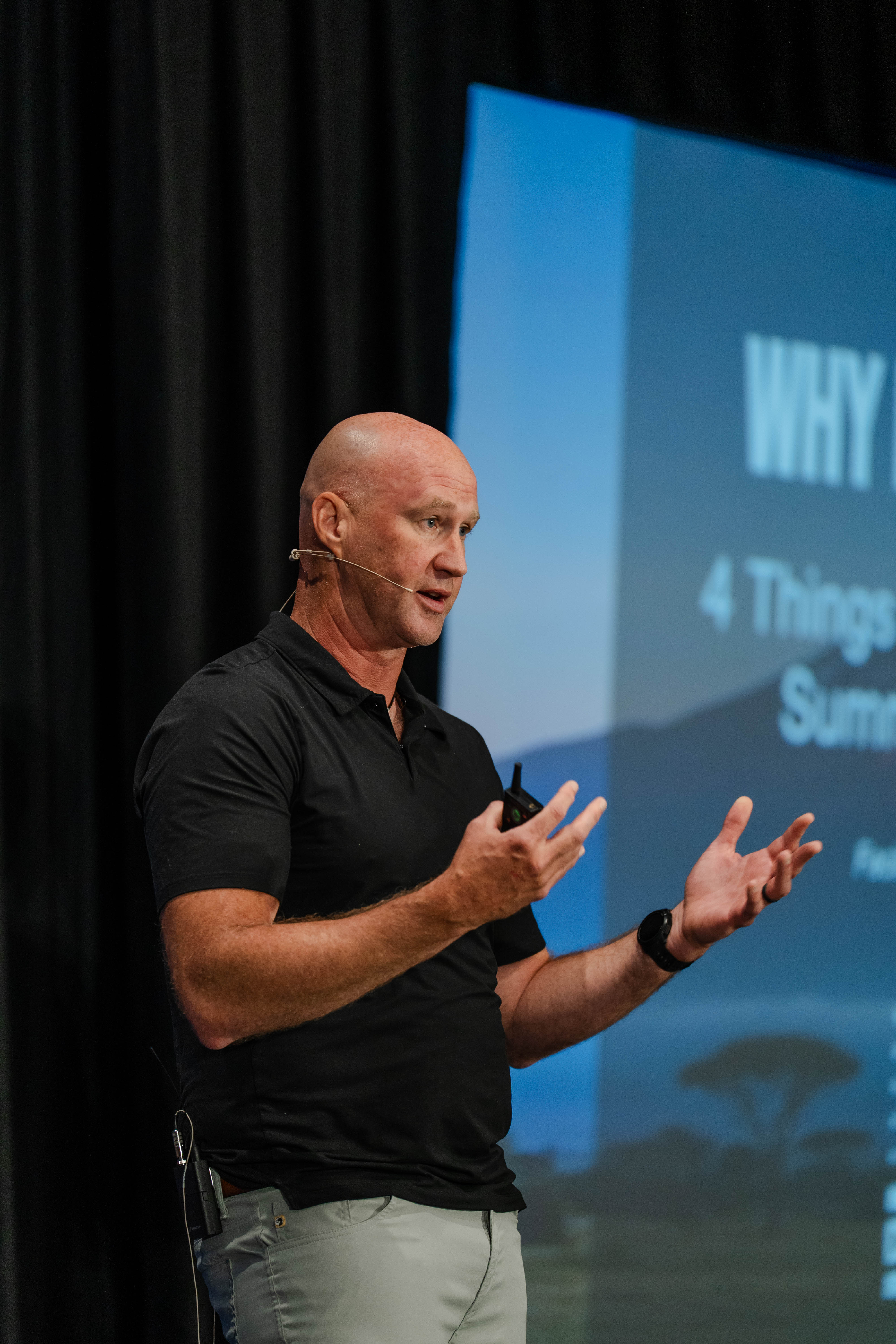
Siegfried "Sig" Tiegs is a keynote speaker, high-performance coach, and co-author of the Amazon best seller Life on Offense: A Tactical Guide to Dominate Life and End Mediocrity. A retired Army Major with 27 years of service, he hosts the Do Hard Things™ podcast and coaches high performers at dohardthingscoaching.com.
Don't miss a beat!
New moves, motivation, and classes delivered to your inbox.
We hate SPAM. We will never sell your information, for any reason.