Why It Gets Hard Before It Gets Better
Sep 01, 2026Why It Gets Harder Before It Gets Better
The Emotional Cycle of Change and the Valley Where Most People Quit
The impediment to action advances action. What stands in the way becomes the way.
— Marcus Aurelius
You started something hard.
Maybe you put something down. Maybe it's a training block, a new business, a diet, a marriage you're trying to rebuild, or the first ninety days in a job that's bigger and more demanding than the last one. Doesn't matter which. The shape of what happens next is the same every time.
Day one was easy.
Day one you were fired up. You wrote it down, you told somebody, you cleared the decks, and you went to bed feeling like a different person. You woke up that first morning and thought, why didn't I do this years ago?
Then it wears off.
How long that takes depends on what you started. It could be a week. It could be a year.
But it comes for everybody, and here's what it feels like.
You're doing everything right and you've got nothing to show for it.
You're training hard, and all you notice is the soreness. Not the gains. The soreness. You step on the scale and it hasn't moved. You built the new marketing plan and ran it and the phone still hasn't rung. You put the thing down and you don't feel better. You just feel like a guy who doesn't get to have it anymore.
And underneath all of it, one question that will not leave you alone.
Is this even worth it?
You're tired. You're short with people. Your spouse has noticed. And the whole project has started to feel less like a mission and more like a punishment you handed yourself for no reason.
And right on cue, the voice comes back.
"This isn't even working."
"You've made your point."
"You were fine before."
"Nobody's counting."
"You can start again in January."
Here's what I need you to understand, and it's the whole reason I'm writing this one.
Nothing has gone wrong.
You're not failing. You're not weak. You didn't pick the wrong thing or the wrong month. What's happening to you right now is so predictable that researchers mapped it in the 1970s, and it's been used to explain everything from technology rollouts to learning curves ever since.
You're in a specific place, on a specific curve, and it has a name.

The Boat
We signed up in January.
The Missouri River 340. Three hundred forty miles, the longest nonstop paddle race in the world. The clock doesn't stop when you do. You have 85 hours to get from Kansas City to St. Charles, just outside of St. Louis, by way of the Missouri River.
My buddy Joe and I signed up as a tandem team, and I want you to understand how good that felt. We could see the whole thing. We talked about the finish line, and it brought back my previous finishes. I'd done this before. Joe hadn't, and it was something he'd wanted for a long time.
So we were excited for different reasons. A lot of excitement and celebration before we'd put a single hour on the water.
That's stage one. Uninformed optimism.
And I want to be clear about something, because I teach this material. I knew the name of the stage I was standing in. Knowing it didn't exempt me from a single day of what came next.
Then we started training.
Here's what nobody tells you about a tandem race. You're not managing a training plan. You're managing two lives. Every long session has to work for both of us, both schedules, both jobs, both families. A four-hour paddle isn't four hours. It's the drive out, the shuttle, the gear, the drive back, and a Saturday your wife and kids aren't getting back either.
Multiply that by two households.
And there's always something better on offer. A barbecue. A kid's ballgame you'd rather be at than sitting in a boat for four hours.
Every one of those was a small negotiation. We can make it up next weekend. One session isn't going to matter.
Somewhere in there the excitement wore off.
That's stage two, informed pessimism. Nothing had gone wrong yet. It just didn't feel anything like it did back in January. Back then it was a finish line I could picture. Now it was every Saturday, every early alarm during the week, everything I said no to. And it was harder than I'd signed up for.
Then we ran the training races.
First one was the Perche Creek Gut Buster. Ten miles, canoe and kayak. Our first race together as a team, in my old Wenonah Sundowner, the same boat I'd raced in the MR340 over ten years back.
We got humbled fast. Finished at the very back of the pack. The only boat we beat was a canoe that dumped twice.
That's when it got real for me. This wasn't going to be a matter of showing up and placing well.
We trained a few more times, and then we took it out on the Missouri for a real river run. Joe's first time on that water.
That's where we lost the boat.
The river was running high that day. We'd planned three or four hours, and the stretch we picked was throwing a headwind at us we hadn't counted on.
That boat is known for stability. That's the whole reason you buy a Sundowner. And we could not control it. Every correction we made, the wind gave right back.
About halfway through, we both knew we should get off the river.
We didn't.
We hit a log, and then we were in the water.
We were in PFDs. That's the only reason this is a story about a canoe.
High water moves a lot faster than it looks from inside a boat. We were in that river thirty, maybe forty-five minutes, working toward an L dike that was breaking the current. Long enough to do some math I didn't like.
We pulled ourselves up on that dike with our paddles and nothing else.
I remember standing there afterward. Soaked. We hugged, thanking God we were both alive, because for a minute there it wasn't a sure thing.
And then the rest of it hit. I was angry and I was sad, standing there watching my canoe float down the Missouri River without me.
We walked back down the Katy Trail covered in mud, paddles still in our hands, our pride floating downstream with my boat, my new sunglasses, and my Bose speaker.
I felt defeated. I wanted nothing to do with that race anymore.
That night was the bottom. We were done. Not "weighing our options" done. Done. The race was months of training away, we didn't have a boat, and after what had just happened I wasn't sure I wanted to be back on that river anyway.
Stage three. The valley of despair.
I've taught this curve for years. I've stood in front of rooms and drawn it on a whiteboard. And there I was at the bottom of my own diagram. Soaked, no boat, embarrassed, ready to walk away from something I'd told everybody I was doing.
Knowing where I was didn't take one ounce of the weight off.
What it did was give me something to do with it.
Because stage three always ends the same way. Not with a feeling. With a decision.
That's what nobody tells you about the valley. You don't feel your way out of it. At some point you sit down and make a call, and there are only ever two answers.
We could quit. And I knew exactly what that bought us, a trip back to stage one on something else. Some new goal, some new January, a fresh round of excitement that would run out in the same place. Because the valley isn't attached to the Missouri River. It's attached to hard things. Change the goal and you just pay the entry fee again later.
Or we could go find a boat and finish what we started.
We found a boat.
Somebody on the MR340 page was selling a 21-foot Current Designs Libre. Tandem kayak, not a canoe. Different boat, different paddles, different everything. It came with the gear we needed and it landed right inside our budget.
So we bought it. And then we had to learn to paddle it, with the race getting closer every week.
I'll be honest, it felt like luck. But that boat didn't show up and change our minds. We changed our minds, and then we went and found a boat.
That's the part nobody tells you about the valley. Nothing gets better while you're standing in it deciding. It gets better after.
A few weeks later we ran the Freedom Race. A hundred kilometers.
We finished in the top twenty-five percent of the field.
Same two guys who'd come in dead last at the Gut Buster, beaten by everybody except one canoe that dumped twice. Now we were in the top quarter.
And the boat was a big part of it. That Libre was stable, it was fast, and it was an upgrade on the canoe I'd been so attached to that I nearly quit over losing it.
We got off the water knowing we were back in it.
That's stage four. Informed optimism. My motivation didn't come back because I dug up more willpower. It came back because we were getting good, and I could finally see the finish from where I was standing.
Fast forward to the finish.
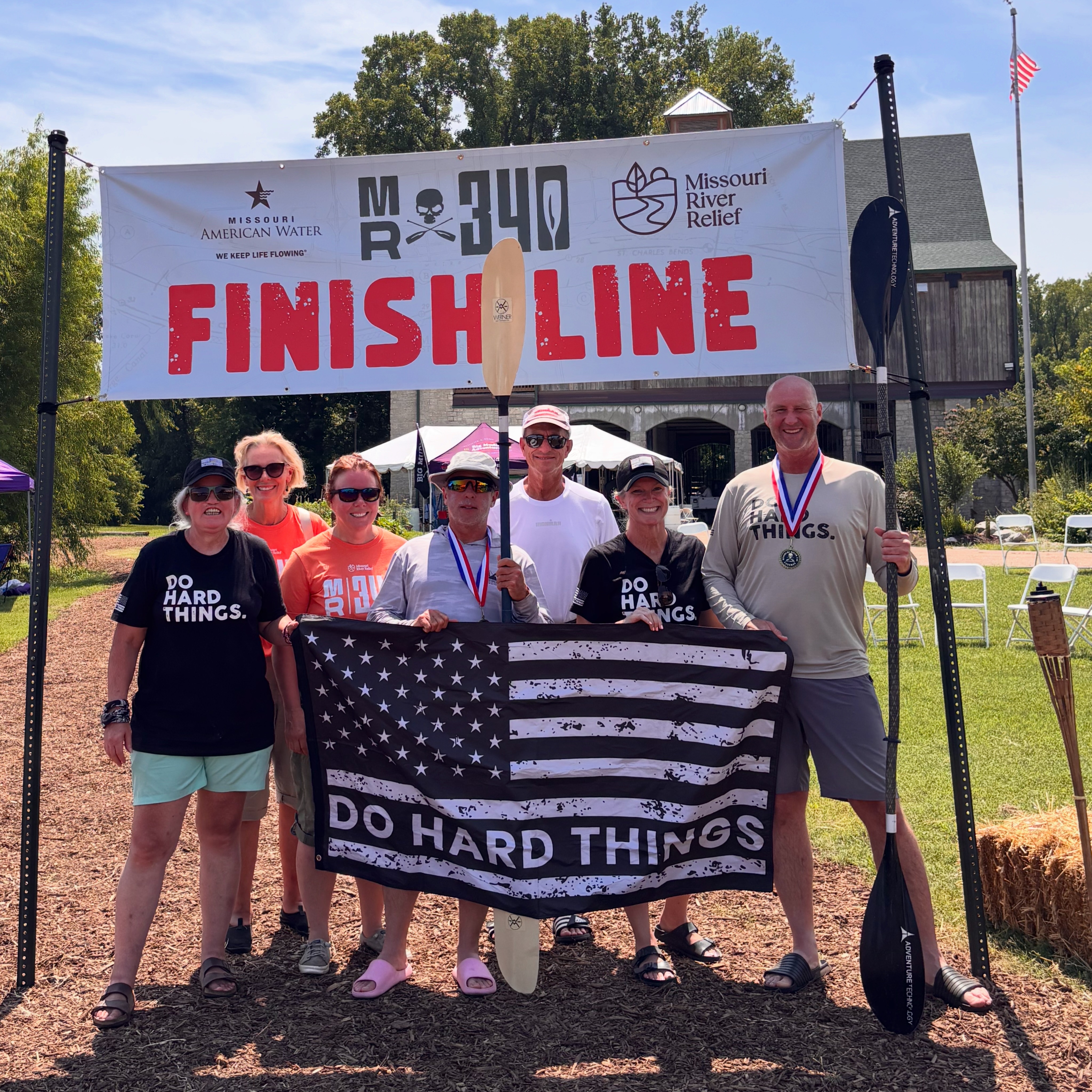
Three hundred forty miles. Joe and I crossed the line together, same as we'd started, in a boat we didn't even own three months earlier. Our families were on the bank waiting, the same people who gave up all those weekends, who worried about us, and who took care of us as our ground crew for 53 hours.
Fifth place tandem. Twentieth overall out of 408.
And you'd think that's what I'd remember. It isn't.
What I remember about that finish is floating in the Missouri River two months before it, watching my canoe go downstream without me, absolutely defeated and done with the whole thing.
That's what was in my head coming across the line. Not the miles. Not the placing. Just how close I came to never being there at all.
That's stage five. And what made it sweet wasn't the finish. It was knowing what we went through to get there. An easy win doesn't land. You savor the ones you paid a price for.
The Bullshit Belief That Makes You Quit
More people get taken out by one belief than by the difficulty ever does.
Bullshit Belief: This isn't working. If this were the right path, why does it feel so hard? Why isn't it inspiring anymore?
Listen to what that's really saying. My feelings are the instrument panel. Fired up means I'm on course. Flat and grinding and dragging myself through it means something's broken.
We've all been sold a version of this. Find your passion and you'll never work a day in your life. If it's meant for you, it'll come easy.
That's one of the most expensive lies going, and it survives on two words we've all gotten a little twisted.
Flow feels like ease, and that's exactly why it fools people. I teach this, and here's what gets missed. Think about the last time you were truly locked in. Three hours gone, never checked the clock, everything just clicking. It felt effortless.
It wasn't. Go back and look at what you were actually doing. The effort was there the whole time. What disappeared was the struggle against it. The second-guessing, the checking the clock, the part of you standing outside the work grading it.
That's what flow removes. Not the work. The friction.
And flow lives right at the edge of what you can do. Too easy and you're bored. Too far past your skill and you're rattled. It shows up in the hardest work you're currently capable of doing well.
So if it's right, it flows has it backwards. Flow doesn't show up because you found something easy. It shows up when you're in spirit and lined up with your purpose, doing hard work you've gotten good at.
And inspiration isn't something you wait for. Most people treat it like it shows up on its own, and when it's gone they sit around hoping it comes back.
Look at the word. Inspire comes from the Latin, meaning to breathe into. Spiritus means breath, and it means spirit. Same root. Ask any medic: inspiration is the inhale, expiration is the exhale. That's not a metaphor I'm reaching for. That's what the word means.
So inspiration was never a feeling that arrives. It's a breath you take.
Here's the truth, and write it down somewhere you'll see it when this gets hard.
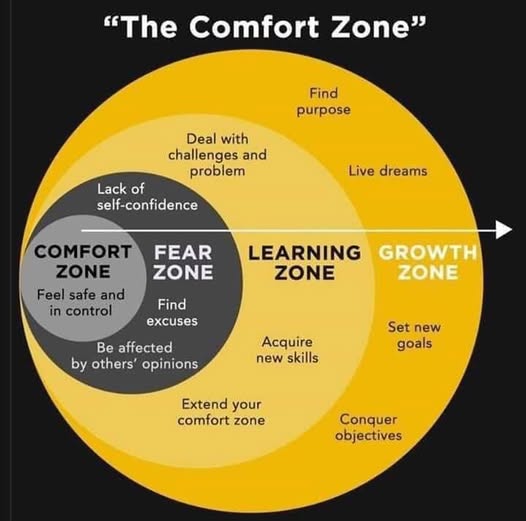
Feeling worse is not evidence that it isn't working. When you're doing something hard, feeling worse is an indicator that you're where you're supposed to be. The friction you feel is you moving outside your comfort zone, which is the only place growth happens.
That is what the edge feels like from the inside.
The Map
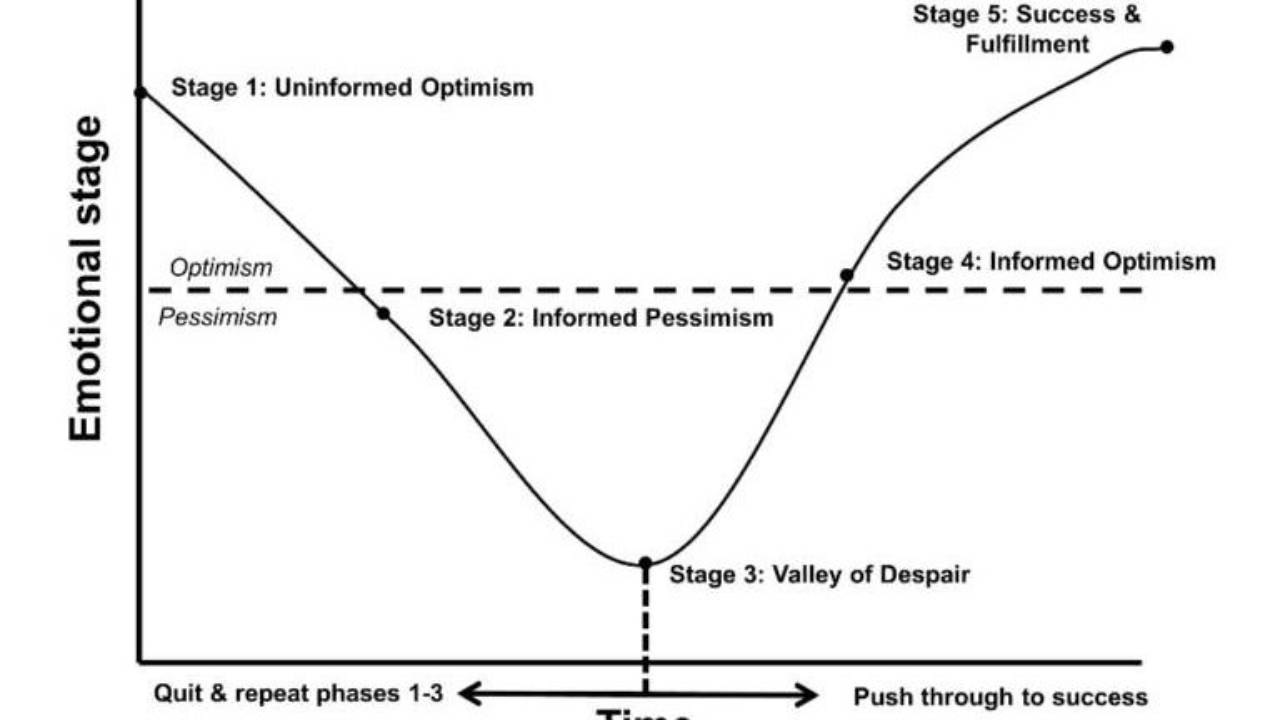
Don Kelley and Daryl Conner mapped this in the 1970s. They called it the Emotional Cycle of Change, and it has five stages.
We use it in the Do Hard Things Nation for one reason: so you can find yourself on the curve. When you know where you are, the feeling stops being a verdict and starts being a location.
Stage One. Uninformed Optimism. The sign-up. You can see the whole thing in your head and it's going to be great. Not because you're naive, but because you don't know what you don't know yet. Enjoy it. It's real, it's just not durable.
Stage Two. Informed Pessimism. Now you've felt the cost. The thing you gave up isn't abstract anymore. Confidence starts leaking out. You're not quitting yet, but you've started running the numbers, and they look worse than they did in the brochure.
Stage Three. The Valley of Despair. The suck. This is where people quit. Not most people who fail. Most people, period. It's your lower self doing the math out loud and telling you the old way was easier. And it's right. It is easier. That's exactly what makes it dangerous.
The valley is where the promise goes back in the drawer.
Stage Four. Informed Optimism. The ground starts to rise. You can see the payoff coming. Your motivation didn't come back because you found more willpower. It came back because you got close enough to the reward to see it.
Stage Five. Success and Fulfillment. You're winning and you know it. And the suck is what makes it feel this good. An easy win doesn't land.
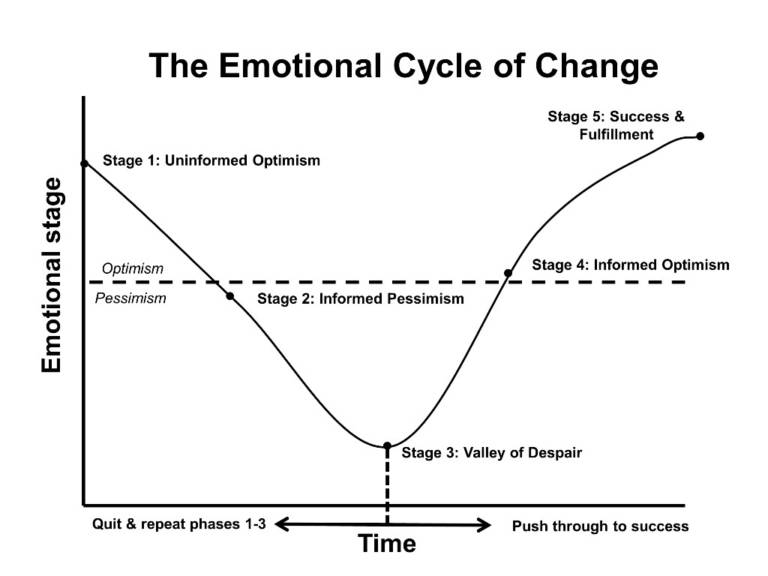
Here's why the map matters.
When you know where you are on the curve, you know what's happening to you. You're not lost. You're in stage three, and stage three has a decision point in the middle of it.
Down there it won't feel like a decision. It'll feel like you've finally seen the thing clearly and you're done. But you can't see stage four from stage three.
So find the decision point and make the call on purpose, knowing exactly which stage you're standing in.
That's the difference between quitting and deciding to press on.
But What If It Really Isn't Working?
Fair question, and I'm not going to pretend it away.
Sometimes the answer is quit. Persistence isn't a virtue all by itself. Standing in a burning building isn't grit.
So here's the quick test, and it cuts cleaner than anything else I know.
The valley makes you hate the process. It does not make you stop wanting the destination.
Floating in that river, I still wanted to finish that race. I hated every step it was going to take to get there. But I never stopped wanting the finish line.
That's a valley. Keep going.
But if you look up and realize you don't want the thing anymore, not "I'm too tired to want it today," but you genuinely don't want it and haven't in a while, that's not despair. That's information.
There's more to this than one test, and it deserves its own conversation. That's next week.
Tactic #1: Find Yourself on the Curve
Before you decide anything, locate yourself.
Ask it plainly. Where am I on this thing? Day one high? Starting to feel the cost? Down in the suck? Climbing out?
Then write it down where you're already tracking. Valley. This is expected.
That's not positive thinking. It's a position report. It's the difference between "I'm lost" and "I'm at grid coordinate whatever, moving north." Same terrain, completely different problem.
And here's the rule that comes with it: you don't get to make decisions from the valley.
Every quit decision I've regretted, and every one my clients regret, got made at the bottom of the curve with the worst possible information.
Decide before you go in. Decide after you come out. Not down there.
Tactic #2: Plan the Valley Before You Enter It
You know the valley is coming. So prepare for it while you can still think straight.
On day one, before the shine wears off, write down your why. Not a sentence. Actually work it.
Who does this impact? Name them. Your wife. Your kids. The people who work for you. The version of you at seventy.
What does it feel like to win this? Get specific enough to see it. Where are you standing. Who's with you. What are you no longer carrying.
How does your life change? What's different six months after you pull this off that isn't different if you quit?
Then add this at the bottom:
At some point I'm going to want to quit. It's going to feel like a good decision. It's the valley, and I'm going through it.
Sign it. Date it. Put it somewhere you'll see it when it gets bad.
Here's why this works. Down in the valley you cannot generate a why. Your head is full of how bad you feel and how far you have to go, and asking somebody in that state to reconnect with their purpose is asking too much.
So you don't generate it down there. You ship it ahead.
Same principle as getting the trigger out of the house. You're not counting on being strong in the moment. You're setting the conditions in advance, back when strength is cheap.
Tactic #3: Get Your Head, Heart, and Feet Aligned
Courage breaks into three parts, and in the valley all three are pulling different directions.
Your head is where the fear lives. This is the part running scenarios. What if I fail. What if people see me fail. What if I've wasted six months on this. Your head is very good at building a case, and down in the valley it builds one against you every single day.
Your heart is where you're connected. To your why. To the people this is for. To something bigger than the discomfort you're in. Your heart doesn't do math. It knows what matters and it doesn't need a spreadsheet to prove it.
Your feet are going to do one of two things. Run, or stay and fight.
In the valley these three come apart. Your head is loud, your heart's gotten quiet under all that noise, and your feet are already drifting toward the exit. That's how people end up quitting things they never consciously decided to quit.
Courage isn't getting rid of the fear. Your head is going to keep talking. Courage is getting all three pointed the same direction anyway.
So let your head have its say without letting it run the show. Get quiet enough to hear your heart, which is where that why you wrote down actually lives. Then move your feet regardless.
The feet are the easiest of the three to command directly. Move them first and the other two usually follow.
Tactic #4: Score the Lead, Not the Lag
In the valley you're staring at the wrong scoreboard.
Lag indicators are the results. The scale. The revenue. The finish time. They only report the past, and they report it late, which means down there they've got nothing to tell you yet. Watch them in the valley and it feels like the world has gone silent on you.
Lead indicators are the things you actually control. Sessions completed. Calls made. Days held. Those you can read today, and today is the only place you can act.
So change what you're measuring. On the days the results won't move, score yourself on the inputs. Did I do the work? Then I won today.
That's a scoreboard you can win every single day, all the way through the valley, while the lag indicators sit there doing nothing.
Measure the input while you wait on the output.
The results will come. They're on their own schedule and they don't care how you feel about it.
Tactic #5: Embrace the Suck. Don't Brace for It.
We say embrace the suck in the Army, and it gets thrown around like a slogan. It isn't one.
Bracing is what most people do. You tense up, you grit your teeth, you wait for it to be over. Bracing is exhausting, and it makes every hour down there feel like an hour spent under a rock.
Embracing is different. You accept the discomfort as part of the deal and get on with it. You find the humor. You laugh at the absurdity of two grown men walking down the Katy Trail covered in mud, paddles in hand, no boat.
With pain comes suffering. But suffering is a choice.
You control your attitude completely, even when you control nothing else. You can go through hell and still find a reason to smile, and the guy who's laughing gets to the other side faster than the guy who's clenched.
Embrace it. Don't brace for it.
The Do's and Don'ts
Don't decide on a bad day. Quit decisions made in the valley aren't decisions, they're symptoms.
Don't confuse a hard day with a wrong plan. Sometimes the plan genuinely needs adjusting. But you can't tell the difference from the bottom of the curve. Adjust after you climb out, not during.
Don't go quiet. Isolation is what the valley wants. When you stop reporting to your witness, that's not a scheduling problem. That's the tell, and both of you should treat it that way.
Don't expect the curve to be one and done. Anything worth doing has smaller cycles inside the big one. Recognizing it the second time is much faster than the first.
Do write down how the valley felt once you're out. You'll need that record next time, and you won't remember it accurately. Success has a way of editing the hard parts out.
Your Orders
There's a question I put to people at the start of a hard change: what's running you that you never actually chose?
Once you've answered that and started doing something about it, the question changes.
Where are you on the curve right now?
Answer it honestly, write it down next to today's date, and then do exactly one thing: keep going for one more day.
Not ten. One.
Because that's the whole trick, and it isn't much of a trick. The valley doesn't get crossed by a heroic push. It gets crossed by somebody who kept showing up while feeling terrible about it, one ordinary day at a time, until one morning the ground started rising and they realized they'd been climbing for a week without noticing.
Grit is what you spend in the valley.
Purpose is what keeps your eyes on the horizon while you're down there.
Peace is waiting at stage five. It always is. It's always last.
Nobody gets to skip the suck. The only choice you have is whether you go through it or turn around, and turning around doesn't save you anything. It just means you'll pay the entry fee again next time you work up the nerve to start.
So find yourself on the curve. Name it. And take one more step.
You're the captain of your ship. Take Command.
Now let's get to work.
---
Siegfried "Sig" Tiegs is a keynote speaker, executive leadership coach, and founder of Do Hard Things Coaching and Consulting. He works with high achievers and their teams who are winning on paper but running on empty, and he leads adventure retreats where the mountain is the classroom and people get back in alignment with their purpose.
A retired Army Major with 27 years of service, Sig hosts the Do Hard Things™ podcast and coaches high performers at dohardthingscoaching.com
Book him to speak here, and check out his best seller Life on Offense: A Tactical Guide to Dominate Life and End Mediocrity.
GRIT. PURPOSE. PEACE.
Don't miss a beat!
New moves, motivation, and classes delivered to your inbox.
We hate SPAM. We will never sell your information, for any reason.