Twentieth: A 2026 MR340 Race Report with Do Hard Things Racing
Aug 07, 2026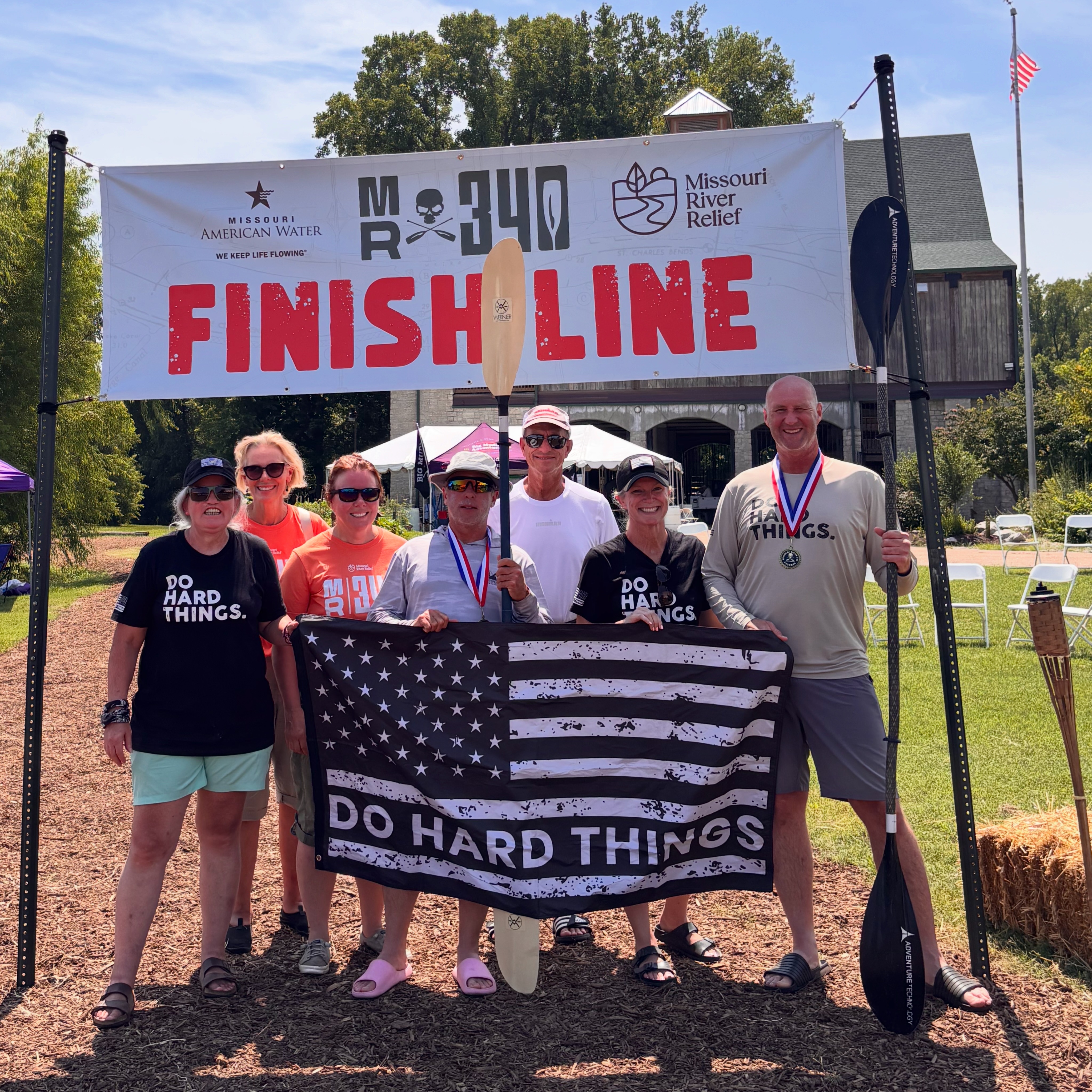
Team Do Hard Things Racing Race Report - MR340 -2026
Team #6969 · Men's Tandem Paddle · Joe Piper & Siegfried Tiegs Kaw Point, Kansas City to St. Charles, Missouri · July 28–30, 2026
FINISH: 53:18:54 — 20th overall of 408 · 5th of 72 in Men's Tandem Paddle
The Missouri River runs 340 miles from Kaw Point to St. Charles. You get 85 hours. We did it in 53, in a 90-pound tandem, on 45 minutes of sleep, in slow water and some of the hottest temps of the summer.
Here's how it went.
THE NUMBERS
Distance: 339.2 miles Elapsed time: 53:18:54 Overall average: 6.4 mph Moving pace: 6.72 mph Total stopped time: 2:50:49 Sleep: 45 minutes Boat: Current Designs Libra tandem, 21'8", ~90 lbs
WHY WE WERE OUT THERE
We were there to challenge ourselves mentally and physically. This was my third MR340 and Joe's first.
We made the decision the year before. We were in Florida visiting friends at the start of the year, sitting around talking about what we wanted to take on next. Joe had a real interest in the 340. I had conveniently forgotten how much it hurts. That's the thing about this race, the memory of the pain fades a lot faster than the memory of the finish line. So we registered and partnered up.
We used the race as an opportunity to spread awareness and fundraise for the Veteran's Community Project. VCP builds tiny homes for homeless veterans, and they get 85% of the people who come through their doors off the street and back into their own lives. Joe and I are both veterans and this cause is near and dear to our heart.
VCP has campuses in Kansas City and in St. Louis. Which means that when we pushed off at Kaw Point and when we pulled in at St. Charles, we were starting and finishing within reach of the work we were paddling for. That wasn't planned. It just happened to line up that way, and I thought about it more than once out there.
MONDAY: REGISTRATION
Joe and I left around 1 p.m. Cory, part of our ground crew, drove up from Arkansas to work the race and rode over with us.
We got to Kaw Point around 3 p.m. It was 100 degrees with a heat index of 110, the kind of heat that makes you question the entire endeavor before you've touched the water. A couple hundred boats were already staged on the ramp, and more coming in behind us all afternoon.
Check-in had a few gates: waiver, RaceOwl app and boat tracking setup, emergency contact, swag. We staged the boat, found our spot, and headed for the Airbnb to meet the rest of the crew, Marie, Betty Jo, Lacy, and Craig.
Dinner was Joe's Kansas City Bar-B-Que, which operates inside a gas station that is still, actively, a gas station. The line was out the door and around the pumps. The burnt ends were worth every minute of it. It's a great last supper before 340 miles, and I'd do it again.
TUESDAY: THE FAST PART
Up at 5:30. Filling water bladders, hauling gear out to the car, running the mental checklist that I would later discover I had not run carefully enough.
We wanted to be on site for the 7:00 solo start. Traffic pushed us into parking lot 4, a decent walk from the ramp, but we had wagons and they earned their keep twice over.
It had rained overnight and the temperature had fallen: overcast, cool, nothing like the furnace of the day before. The sunrise came up over the river and it was one of the most beautiful things I saw all week. Whatever else happened, we were getting a gift of a morning.
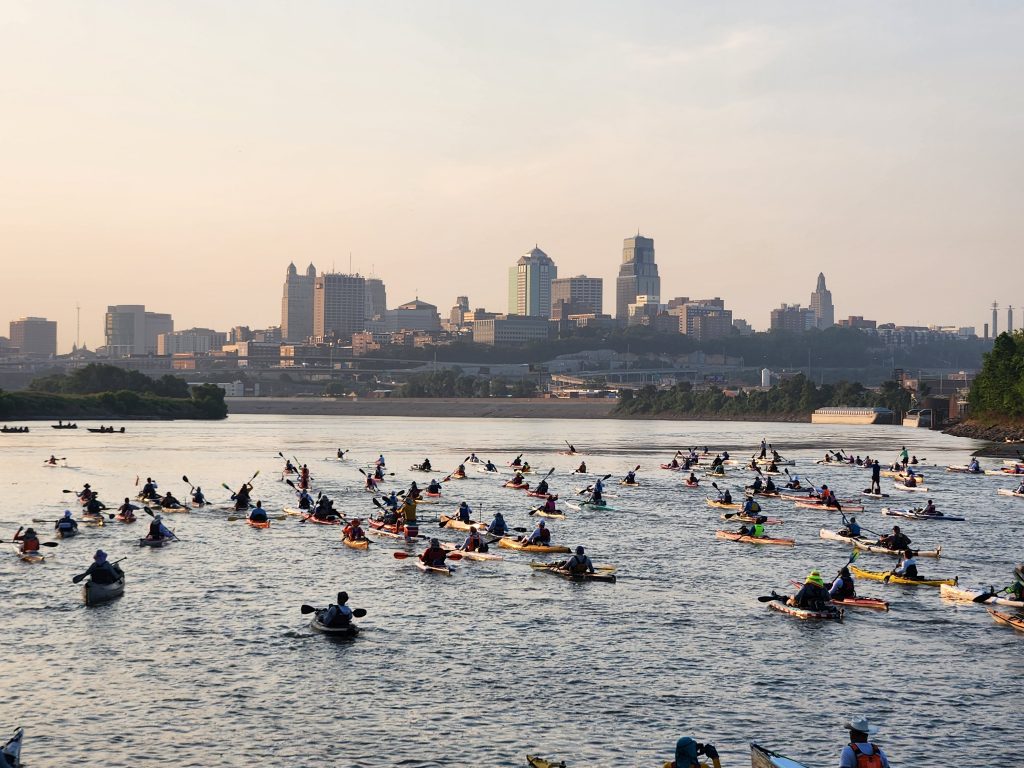
We made it down five minutes before the solos launched. National anthem. A few words of encouragement. The countdown. And then a few hundred boats went quiet and disappeared downstream.
Then it was our turn to rig: water bladder, food, paddles, PFDs, pee bottle, phone and GPS and batteries, lights. My phone and watch were having charging issues. I felt excited and calm, but underneath that I was having real trouble concentrating, and it showed up in the details: I left my cockpit cover behind, forgot my Crocs, never did get the phone and watch charging sorted out fully. Flustered at exactly the wrong hour.
The ramp line moved better than I expected. Joe and I got in, paddled up to the shoreline, and there was our ground crew. Danielle from Veteran Community Project came down with swag and we took photos. My friend Clay, who lives in KC, showed up to see us off.
8:00 AM — KAW POINT.
The countdown and the start are exciting. I wasn't nervous, it was more of a confident calm, the kind you only get from having done a thing before. But I also know the start is where boats touch, and a flip in the first mile can end your race before it's begun. Lost time you'll never get back, or a DNF with 339 miles still in front of you.
We lined up on the left side of the field. Boats were jockeying hard, closing on each other, everybody wanting clean water. One white canoe cut a hard left directly across our bow and we had to throw in an evasive maneuver to keep from hitting them. Frustrating way to start.
A few minutes later it thinned out and we were in our own open water.
Our strategy was simple: find the sweet spot. Don't go too hard too early. Don't burn ourselves down on day one and spend the next two days paying for it.
The first thirty miles went by at 7.6–7.8 mph. Riverfront Park, LaBenite, Cooley Lake, Ft Osage, barely a pause between them. Through Ft Osage at noon with 30.5 miles down in four hours.
The river was smooth that morning, overcast, temperatures in the 70s. People were out on the banks cheering total strangers, which never stops being strange and never stops working.
All day our crew leapfrogged ahead with resupply. They flew the Do Hard Things flag at every stop, which was a plan we'd made in advance and one of the smartest things we did. Finding your people from the middle of the river, in a crowd of hundreds, is genuinely hard, but that flag stood out every single time. I also carried a monocle, which turned out to be one of the best pieces of gear I brought. Crew spotting, mile markers, reading what was coming.
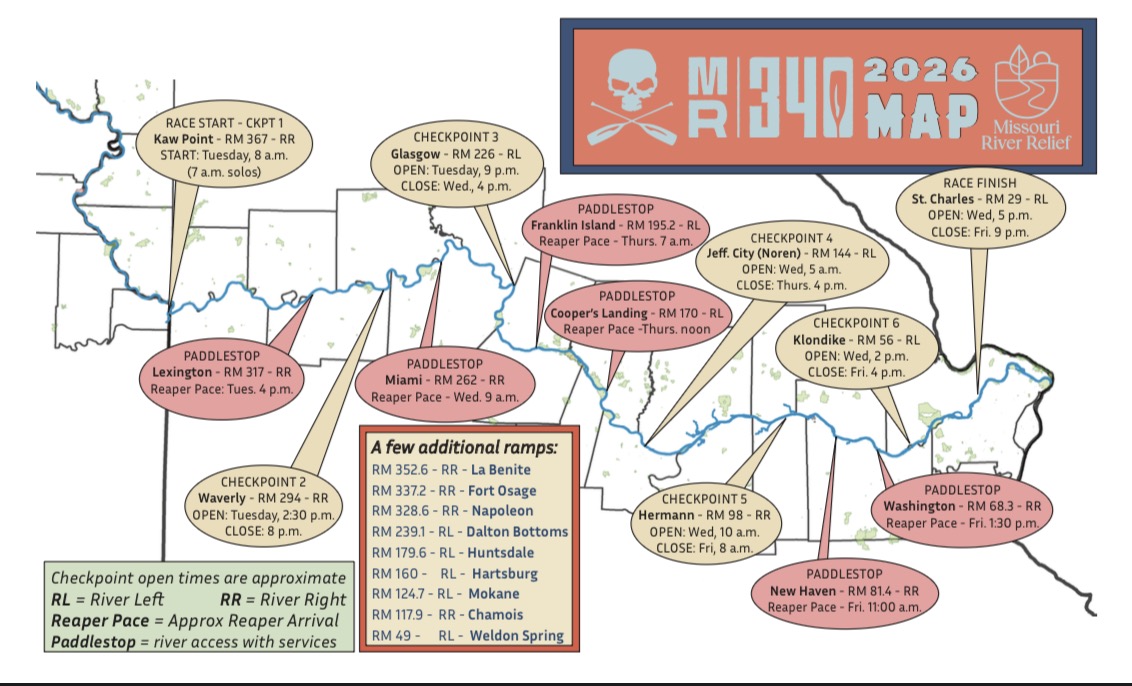
LEXINGTON, MILE 51.3, 2:53 PM. Seven minutes on the bank, our longest stop of the day.
The crew met us with nutrition resupply and two McDonald's cheeseburger meals with fries and a Coke. I normally forgo these and only eat them during a race. I can't remember the last time I had McDonald's. Before the race I had joked that I wanted Lacy to make me cold smoothies out there. She actually bought a blender at Walmart, brought it to the riverbank, and made one.
My first honest reaction was concern, if I eat all of this I'm going to be sick. I ate all of it. It was the right call. The lift it gave us was out of all proportion to the calories, and we needed it, because by then the sun was fully out and it had gotten hot. There is no shade in a kayak. There is nowhere to go. You are exposed for as long as the sun is up.
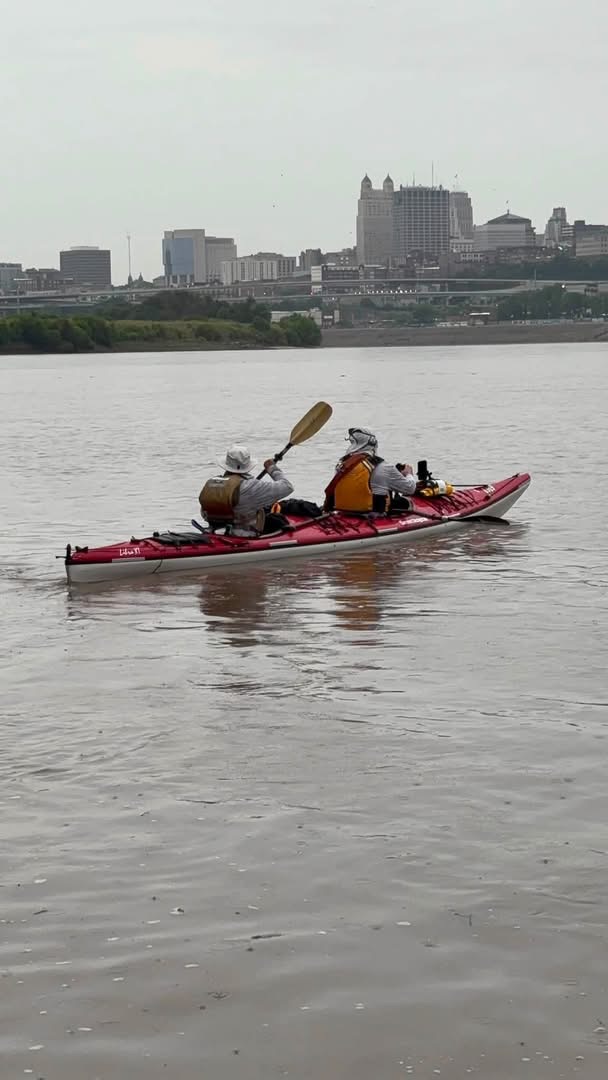
WAVERLY TO MIAMI — 23 miles, then 12, then 18, still holding 7.0–7.3.
We rolled into Miami at 10:30 PM with 104.9 miles down in fourteen and a half hours.
Miami was quick, and that ramp gets busy. Our night signal was a chemlight on a rope. As we came in I'd call the crew, they'd spin the chemlight in a circle, and I'd lasso them with a green laser pointer so we could find each other in the dark. It sounds elaborate. It works really well.
Coming into a ramp against the current isn't easy on a good day. Add a crowd of tired, nervous paddlers all trying to land in the same place and you have real traffic.
We felt the whole day sitting in us at that point, tired, but in genuinely good spirits. One hundred five miles down. Two hundred thirty-four to go.
TUESDAY NIGHT: NO STOPPING
We made a deliberate call not to sleep on night one. Three reasons:
Night time is much cooler to paddle in. Getting back into a boat after you've stopped is brutally hard. Adrenaline makes real sleep nearly impossible that early anyway.
So we ran it.
The overnight paddle was smooth. We crossed paths with a few boats but never settled in with a group. Dalton Bottoms at 2:05 AM. Glasgow at 4:02 AM.
Glasgow is the stop where many teams pull off for the night, there or at a checkpoint before it. We were exhausted but we pressed on. From that point the race got lonely in a way I hadn't experienced before. As the sky started to grey it went eerily quiet. Nobody ahead. Nobody behind. Just the two of us and the river, and me wondering whether or not this was the right call.
The way I kept my head around it was car racing. The yellow flag comes out and most of the field pits for fresh tires. A few cars stay out on old rubber, give up grip to gain track position, and try to hold on when the green drops.
That was us. Take the cool hours at a slower pace, bank the position, and pray we could hang on when the field woke up rested and came at us hard. It's not a comfortable strategy. You're spending something you can't get back and you won't know for another thirty hours whether it was worth it.
I think that stretch put us inside the top 25.
The moon was extraordinary that night. It threw enough light that we barely used our headlamps. The river laid out silver in front of us for miles. The gnats were less extraordinary. They fly into your eyes, your ears, your nose, and you will swallow a few. There's not much of a defense against them.
We fought the Z monster with caffeinated gum and conversation. The hallucinations came on, and honestly they can be spectacular. The clouds, the moon, the trees along the bank all start taking the shape of animals and dinosaurs and monsters. Great crowds of them lining the banks. It almost feels like they're out there cheering you on.
The low points were nodding off mid-stroke, and the soreness setting hard into my shoulders and elbows. Sitting that long takes a toll nobody warns you about properly. My backrest had been rubbing my back raw for hours. This is the part of the 340 that isn't athletic at all, it's just endurance of discomfort, hour after hour, with no position to shift into that helps.
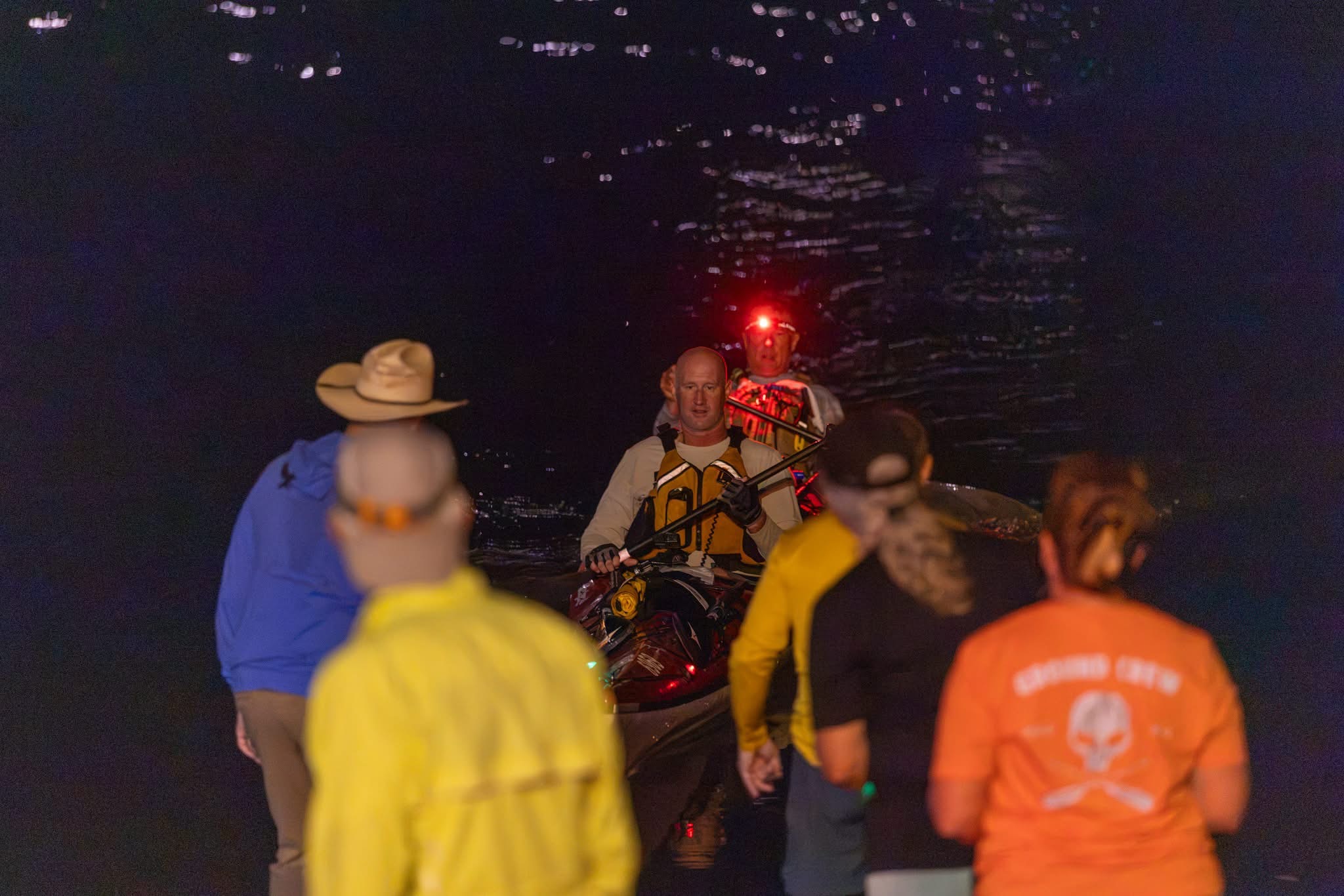
WEDNESDAY MORNING: THE LONG HAUL
FRANKLIN ISLAND, MILE 172.8, 8:38 AM — the end of a 31-mile leg, the longest stretch of the race. Our pace held between 6.7 and 6.8 through the dark, which I'm proud of. But thirty-one miles is a long way to cover without seeing another soul when you're that tired.
The sun came up and we finally ran into another boat. We met Beth, on a pedal drive, and talked with her a few minutes, the first new voice in hours, and it was like a shot of caffeine. Then we spotted a canoe with three paddlers and matched their pace for a while. Right up until a fourth person sat straight up out of the hull and stretched his arms over his head. He'd been down in there sleeping the entire time we'd been racing them.
About a mile from Franklin Island there's an old train bridge. As we came under it we heard "DO HARD THINGS!" echo off the water, a familiar face up on the bridge, waiting there for us.
Then a barge came up fast behind us just as we were setting up for the ramp. The ramp is river left. So is the channel.
Joe and I had a short argument about it. He wanted to cross river right, out of the barge's path, because they kick up a lot of water. We were close enough to the ramp that I didn't want to go all the way across and then have to come all the way back. Our boat could take the waves. We tucked in behind a wing dike on river left instead.
He was right and I was wrong. Crossing was the correct call. I was stubborn and I was tired and those two things are a bad combination on a river. As it happened, the barge was headed downstream and the waves weren't bad and none of it mattered, but that's the wrong reason to be right.
At Franklin Island we were genuinely wrecked. We could have gotten out and slept right there and nobody would have blamed us. But Cooper's Landing was the plan, so we took a quick nutrition resupply and pushed off.
The stretch to Cooper's is one of the most beautiful parts of the whole river and one of the meanest. The bluffs near Rocheport channel the wind, and we paddled straight into a hard headwind that took our pace apart.
Tired, into the wind, with the sun coming up and 140 miles still ahead of us, there were real moments of what the hell am I doing out here. And it happened on our home water, the exact stretch we train on constantly, the stretch where we'd lost our canoe just a couple of months before. There's something particularly demoralizing about suffering on water you know by heart.
At Hartsburg there were friendly faces on the bank yelling for us. The headwind finally eased. The temperature started climbing to take its place.
Hartsburg to Cooper's felt like an eternity. Everything had caught up at once — the wind, the missing sleep, the accumulated hours in the seat. Every stroke hurt and the ramp never seemed to get any closer.
WEDNESDAY: COOPER'S LANDING
By Taylor's Landing and Huntsdale we were down to 6.2–6.3 mph. Twenty-eight hours in, no sleep, and the hottest day of the race climbing into the sky ahead of us.
COOPER'S LANDING, MILE 197.9. In at 12:40 PM, out at 2:15 PM — one hour, thirty-four minutes.
This was the stop that mattered. We were both looking forward to getting out of that boat but neither of us could do it alone. We were like baby deer, learning to walk for the first time. Lacy and Cory got me under both arms and walked me up the ramp to the 4Runner.
Changed clothes. Food. A Coke. My friend Laura put an IV in my arm for hydration and I laid down in the back for a nap.
It took a while to actually fall asleep, which is its own kind of frustrating. I wanted to know our position. I wanted to know how long we were staying at this checkpoint. Twenty-eight hours awake and the adrenaline still won't let go of you. Joe found his wife Betty Jo and Marie and slept out on the ground.
We came into Cooper's in 20th place. We slept about 45 minutes. We left in 25th.
That's the arithmetic of rest in this race, and there's no way around it. Five boats went by while we were horizontal. You can either accept that or you can pay for it later, and we'd already decided which side of that we were on.
Getting back in the boat was hard, especially knowing how much river was still out there. We came out running 6.7 through Hartsburg and Marion, and for a little while it felt like we'd started a new day.
THEN THE AFTERNOON.
It got extremely hot and the water felt slow, which is a thing you can actually feel in a boat even when you can't prove it. We made a short stop at Jeff City at 6:19 PM for a cold Coke and nutrition and got straight back out.
Jeff City to Mokane was the hardest stretch of the race. We hit Mokane at 9:29 PM having run 6.3 and 6.1 mph.
Looking at the data afterward, it wasn't just us. Nearly every boat in the top ten posted their worst splits of the entire race through Jeff City and Mokane on Wednesday afternoon. That stretch took its toll on everyone.
It's hard because that's the exact point where the soreness and the exhaustion are fully present and you still have more than a hundred miles to go. The math is not encouraging. The heat made all of it worse.
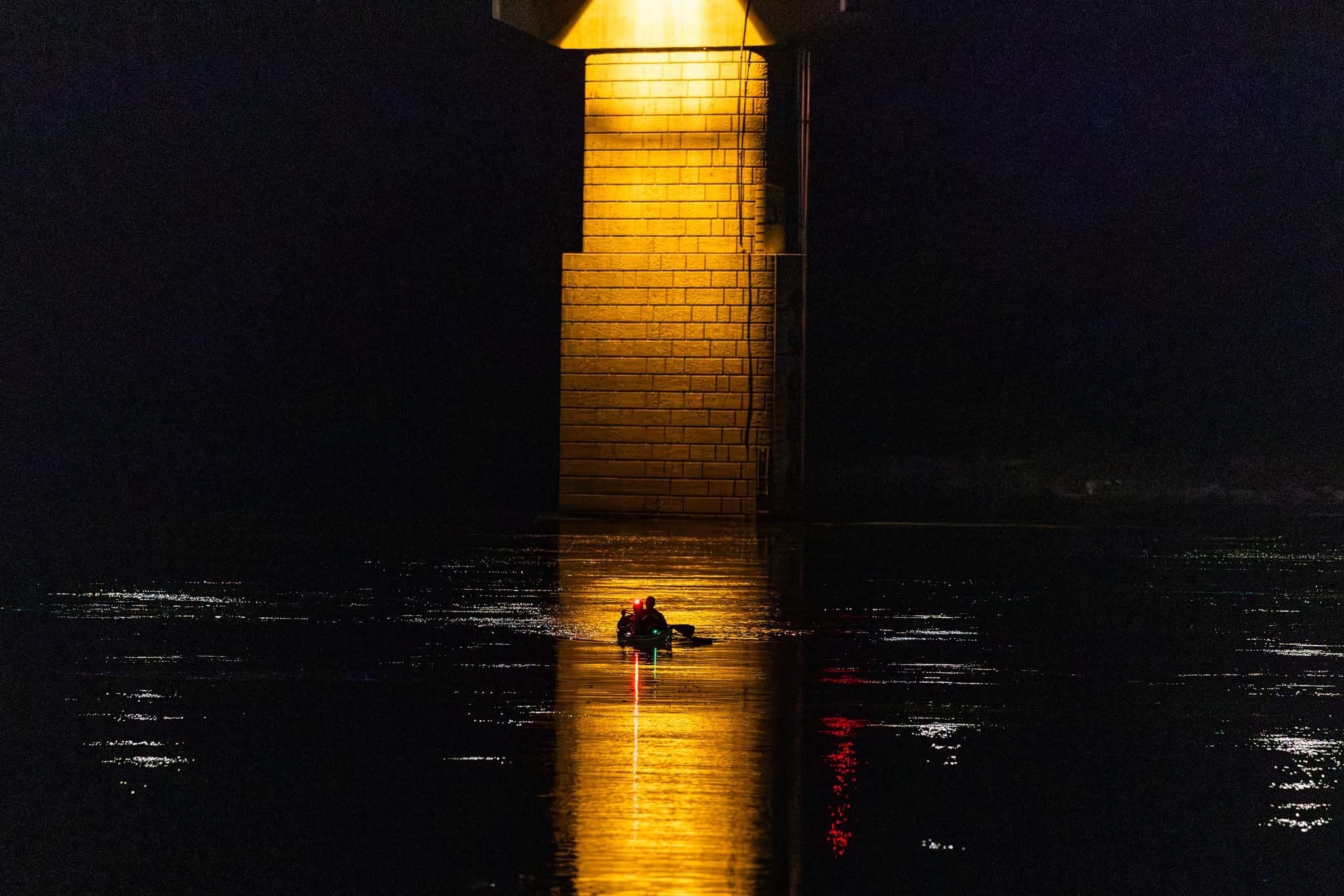
WEDNESDAY NIGHT INTO THURSDAY
Night two was tougher than night one, and it wasn't close.
The hallucinations got strong enough that we had trouble telling what was real. Is that light another racer, or is it nothing at all? You stop trusting your own eyes, which is a strange thing to experience while operating a boat in the dark.
Every stroke hurt by then. Despite being in pain, we found a lot of laughter in the hallucinations and the absurdity of what we were attempting to do. Somewhere in there we met a stand-up paddleboarder who was absolutely flying, headwind and all. His GPS was giving him trouble so he followed us into the Chamois ramp. He was more of a conversationalist than Joe or I were at that point. The SUP paddlers on this race are, to me, the most impressive people out there. Forty-plus hours standing up.
We floated past Chamois, which looked busy, and kept pressing toward Hermann.
When you round the last bend into Hermann you see the bridge and it looks like it's a mile away. It is not. It's several miles, and it takes forever, and if you happen to badly need a bathroom it becomes genuine torture. The hallucinations had turned that bridge into a gate, and paddling toward it felt like paddling on a treadmill — stroke after stroke, and the gate never got any bigger. Trains kept rolling through and their lights made the trees look like something out of a film.
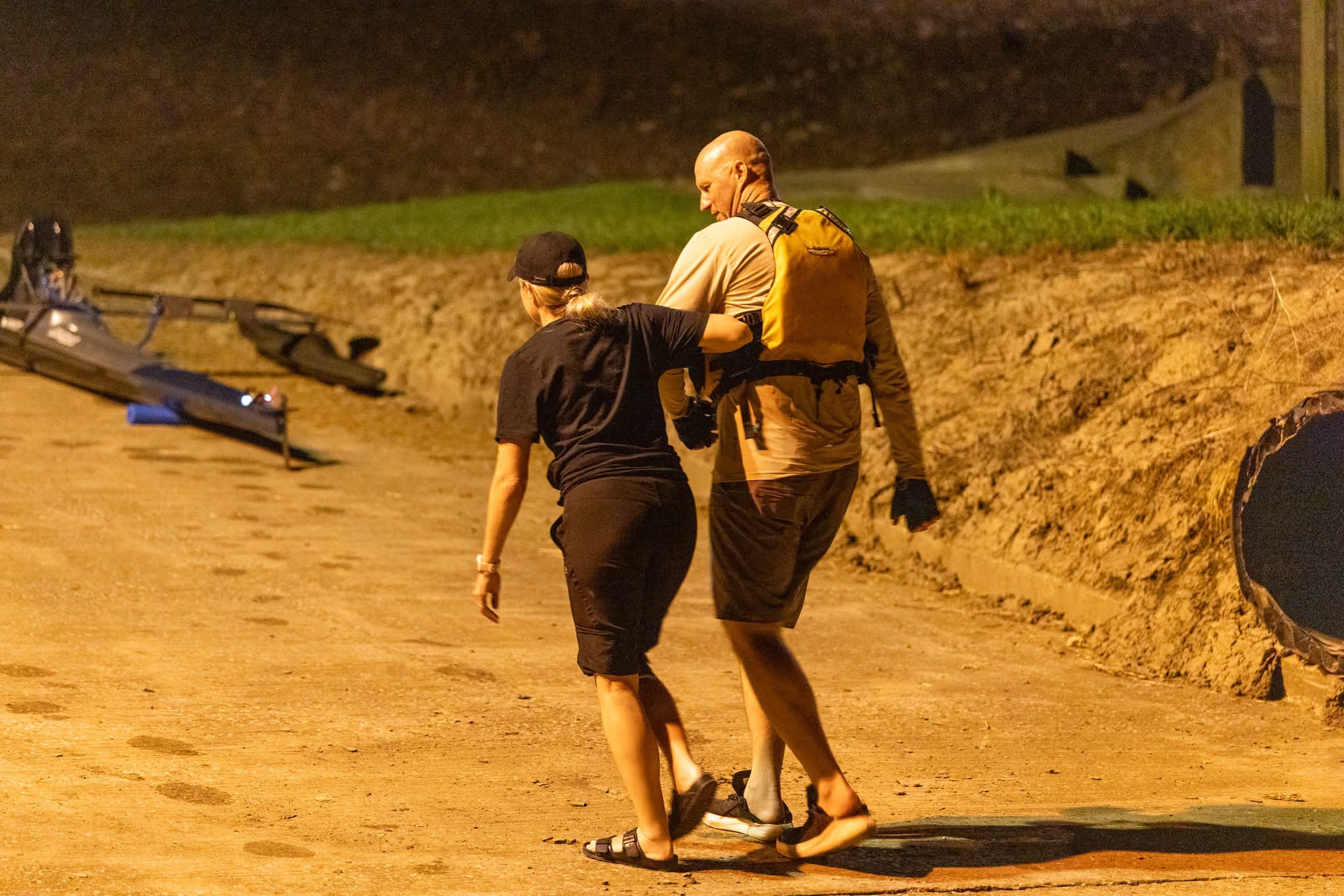
HERMANN, 1:48 AM — 25 minutes.
I could barely walk when I got out. Lacy grabbed hold of me and we made a beeline for the porta-john. Afterward she gave me a steak, and a kind woman from some other team's ground crew handed me cookies — that happens out here constantly and it never stops meaning something.
At some point I just fell over. Couldn't stand up. I remember the whole thing happening in slow motion, thinking "huh, I'm going down," with no ability whatsoever to do anything about it.
We left Hermann in 21st position. We tried to run the math on whether we could hold position and still get sleep. We decided to press on. Forty-two hours in and we were still choosing the harder option, which tells you something about the state of our judgment or the state of our stubbornness.
Back on the water the fog rolled in, which can be genuinely dangerous when it takes your visibility to nothing. That stretch has more buoys and wing dikes than most, and the fog made every one of them a problem. There was a nerve-racking stretch of hunting for buoys — you could hear them but not see them well through the layer of fog developing. We were watching it and hoping it wasn't going to thicken any more and force us off the river. We wanted to push hard and get through, and couldn't go as fast as we wanted without risking hitting one. Finally, after the bluffs, the river opened back up and we could regain speed.
NEW HAVEN AT 4:44 AM, straight through. That whole stretch was rough. Even with the sun coming up, we were wrecked, and I needed a bathroom again badly.
WASHINGTON AT 6:54 AM — 20 minutes. The sun was up, the crew was there in good spirits with nutrition, and they got me to a bathroom.
This may be more than anyone needs to know. One of the real challenges of this race is peeing in the boat, and I had some difficulty getting into the bottle and ended up splashing myself pretty badly. I remember standing in that bathroom, smelling myself, throwing my underwear in the trash and washing my shorts in the sink. A guy walked in, took one look, and clearly decided he wanted no part of whatever was happening. Forty-seven hours will take your dignity if you let it.
We got back in the boat solidly in 20th.
KLONDIKE AT 9:04 AM. WELDON SPRINGS, MILE 319.5, 10:29 AM. Twenty miles to go, and that split came in at 6.0 mph — the slowest of our entire race.
THE LAST TWENTY MILES
Which brings us back to Weldon Springs.
We were out of gas. Nineteenth was over an hour up the river and clearly gone. We believed we had a comfortable cushion behind us. With nothing to chase and nothing chasing us, we'd quietly stopped racing.
Then the crew told us 21st was closing in.
We picked it up a little, figuring that would be enough. Then we looked back and actually saw him — a solo kayaker, coming hard. We'd seen him the day before. We knew exactly how fast he was.
Joe and I made the call right there on the water, and it didn't take a conversation. We had worked for this position for two days and two nights. We were not going to hand it over in the last twenty miles because we were tired. If he wanted it, he was going to have to come take it from us.
We leaned in and gave it everything that was left.
We covered the final 19.7 miles at 7.0 mph: our fastest split since hour fourteen, and faster than the man who won the solo division covered the same water. Fifty-one hours in the boat and we found another gear, which I still don't entirely understand.
He never got us.
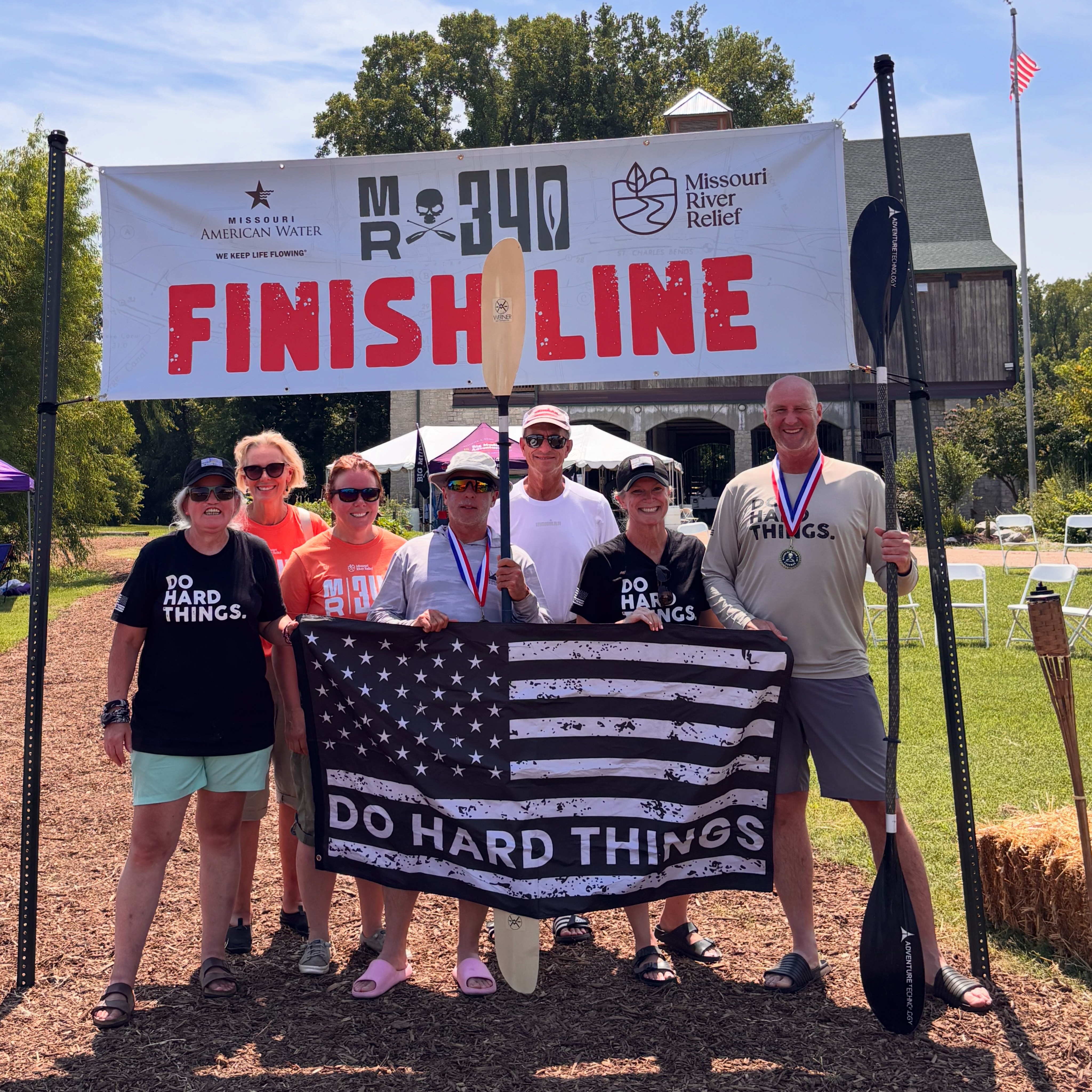
ST. CHARLES, 1:18:54 PM THURSDAY. 53 HOURS, 18 MINUTES, 54 SECONDS.
Our entire ground crew was at the finish with the Do Hard Things flag up, and a crowd of people cheering us in. We paddled hard all the way to the line, because after all that it seemed like the only appropriate way to arrive.
Getting out of the boat was hard and it was hot. I hugged Joe. Then our families walked us up to the park at the top of the ramp and I sat there drinking a Coke while Lacy sprayed me off with a garden hose like a farm animal, which was the single best thing that has ever happened to me.
We were all smiles. I was so happy with the time, the result, and the effort. So happy to have a crew that supported us that well. And so happy to have had a teammate who never quit and never complained — not once, in 53 hours, and I would know.
WHAT WE GOT RIGHT
Stop discipline. Twenty-three minor checkpoints, 22 minutes total across the entire race. NASCAR style. For comparison, the second-place solo finisher spent 11 minutes across 23 of his checkpoints — we were operating near the same standard as a podium boat.
Pacing judgment. We held 85% of our fresh-legs pace across 53 hours. Every boat that finished ahead of us in our division faded harder than we did: the division winner held 77%, the third-place boat 80%. By the numbers, we were the most efficient boat in the top five. We ran out of hull before we ran out of engine.
The crew. They gave us exactly what we needed exactly when we needed it, and they encouraged us the whole way. They understood our goals well enough that when we were too tired to think, they kept us on plan and fed us the information we needed instead of the information we wanted. They went well beyond the job — hot food, Lacy's smoothie, hauling our trash, dealing with our smell, picking us up off the ground, and the entire Cooper's Landing stop ran like clockwork. This race is billed as a two-man effort. It was never a two-man effort.
Finishing strong. Negative-splitting the last leg after 51 hours in a 90-pound boat was quite a feat and we are thankful for that push. Otherwise we would have spent an extra hour out there roasting in the sun.
WHAT WE'D DO DIFFERENTLY
The boat. The Current Designs Libra is a beautiful expedition tandem, a true Cadillac, and it served us well for what we asked of it. But if we want to compete for a podium, we need a different hull. Over the first thirty miles, same water and same hour, the division winner ran 9.57 mph to our 7.65. That's a 25% gap between two tandems with two paddlers in each, before fatigue, before heat, before anything else had a chance to happen. Most of our deficit was bought at the boat shop, not lost on the river.
My phone. It got wet, and it already had charging problems going in. Next time I'll run a dedicated race phone with a better mount, a screen I can actually read in the sun, and a charging setup I trust.
A gear checklist. I should have double- and triple-checked, and I didn't. That's how I ended up on the water without my deck cover, my Crocs, or sunscreen. None of them ended our race. All of them cost something.
WHAT IT WAS FOR
Somewhere on Wednesday afternoon, between Jeff City and Mokane, in the worst heat of the worst stretch, I remember thinking about the fact that this was voluntary. We signed up for this. We paid money to be here. We could stop any time we wanted. What a great luxury to choose to do this.
That's the whole point, and it's also the uncomfortable part. We chose our suffering and we got to choose when it ended. The veterans that VCP serves did not choose theirs, and it does not end at a finish line with a garden hose and a cold Coke and people cheering.
Fifty-three hours is a long time to sit with that.
Do hard things. Not because they're hard for their own sake, but because being willing to do them for someone else is most of what the phrase is worth.
THANK YOU
To our ground crew — Cory, Marie, Betty Jo, Lacy, and Craig — thank you. You ran a leapfrog operation for 53 hours in triple-digit heat so that two guys in a boat could keep moving. You didn't sleep either, and nobody hands out medals for that.
To Laura with Pure Fix IV Hydration, for being at Cooper's when we needed it most.
To Nancy Yeager owner of Fleet Feet, Columbia, Mo; for supplying us with new water bottles.
To Dr. Nicholas Hagan at Advanced Physical Health, for the last-minute adjustment that got me ready for the race.
To Danielle and everyone at Veterans Community Project, for the work you do all year, and for coming down to the ramp.
To our families, for absorbing the training hours, the gear, the expense, and the general nonsense that comes with deciding to paddle across a state.
And to the MR340 organizers, Missouri River Relief, and the volunteers: people who stand on a riverbank at 3 AM for strangers, hand out cookies, and point tired paddlers toward the porta-john. This race does not exist without you.
339.2 miles. 53 hours. Two teammates. One boat. A crew of people helping.
DO HARD THINGS.
Don't miss a beat!
New moves, motivation, and classes delivered to your inbox.
We hate SPAM. We will never sell your information, for any reason.